Deep Listening: Exploring Music with Dan Asia
27 June 2025
Hazaq u’Barukh to President of the Sephardic Home Foundation and Distinguished ASF Board Member, Dr. Joe Halio, who received the Cedarhurst Sephardic Temple Journal Testimonial Award at the Sixty-Second Testimonial Reception and Reconsecration Service last Shabbat (21 June). Te felisitamos de Dr. Joe Halio, por este rekonosimiento muncho meresido!
Click here to dedicate a future issue in honor or memory of a loved one

Upcoming Events ◊ ASF Sephardi Shop ◊ Sephardi World Weekly ◊ ASF IJE ◊ ASF Sephardi House ◊ Archive◊ Donate
The American Sephardi Federation’s Sephardi Ideas Monthly (SIM) by Dr. Aryeh Tepper is a continuing series of essays and interviews from the rich, multi-dimensional world of Sephardi thought and culture that is delivered to your inbox every month.
Daniel Asia is an award-winning and critically celebrated classical composer whose opera, “The Tin Angel,” premieres this Saturday, June 28th, at La MaMa in downtown Manhattan. Asia is also the President and Founder of Polyhymnia (previously, The Center for American Culture and Ideas), and a widely-published author. An active member of his Jewish community and a proud Zionist, Asia organically practices the kind of rooted cosmopolitanism that resonates naturally with the Classic Sephardi tradition.
The ASF’s Director of Publications, Aryeh Tepper, is a Senior Fellow at Polyhymnia, and he and Asia are longtime friends.
Continuing SIM’s series on music, Asia and Tepper recently sat down to explore Asia’s thoughts on the connections between classical music and Judaism, the soundscape of Mt. Sinai, developments within modern music, King David, Rabbi Uziel, Asia’s new opera, and more.
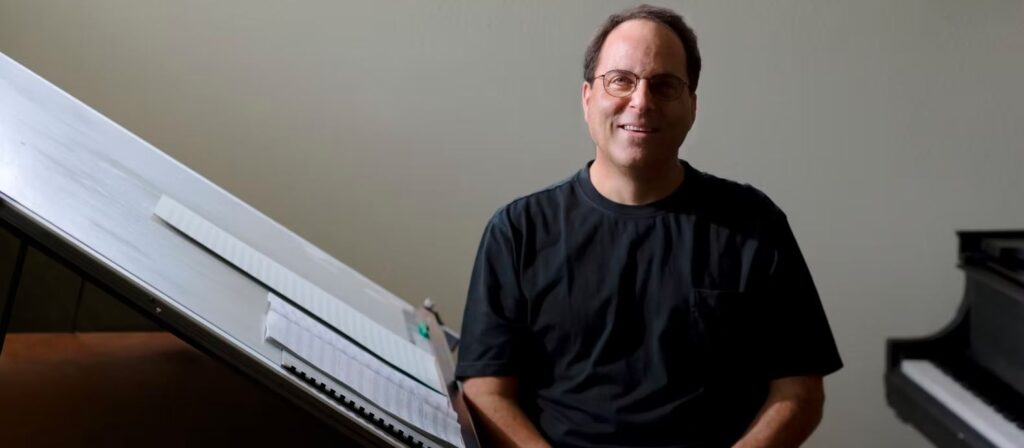
(Photo courtesy of Daniel Asia)
Sephardi Ideas Monthly: Thank you for being with us, Maestro. Part of what makes your perspective as a composer unique is the way in which you connect classical music and Judaism. Please say a few words about the connection.
Dan Asia: Sure! I believe that both classical music and Judaism aim at connecting us to a transcendent dimension. Life is not only the physical or material.
I learn from the writings of Rabbi Abraham Heschel. He loved the term “the ineffable.” At peak moments, we encounter a reality that is radically “other.” There is something ineffable, through which we are touched by something Divine. How do we remain open to this transcendent dimension? Through awe and wonder, through awareness of the mystery. In this context, check out the following passage from Heschel’s The Insecurity of Freedom:
The only language that seems to be compatible with the wonder and mystery of being is the language of music. Music is more than just expressiveness. It is rather a reaching out toward a realm that lies beyond the reach of verbal propositions. Verbal expression is in danger of being taken literally and of serving as a substitute for insight. Words become slogans, slogans become idols. But music is a refutation of human finality. Music is an antidote to higher idolatry.
I love that, “Music is a refutation of human finality.” Words circumscribe. The range of expression is finite, and there is a danger of getting lost in the words, in language, and closing ourselves to reality that is beyond language. But instrumental music is open ended, and through it, we remain open and receptive.
In this way, it’s like prayer. There are words on a page that we read, but there are also songs that lift the words that we sing off the page, that elevate the experience to communion with the ineffable.
SIM: That’s beautiful. But there is another dimension. In your essay, “Breath in a Ram’s Horn: Why Classical Music is Like Jewish Prayer,” you write that classical music and Judaism both facilitate religious experience through a thoughtful shaping of time.
DA: Yes. Again, Heschel points the way:
Judaism is a religion of time aiming at the sanctification of time. Judaism teaches us to be attached to holiness in time. The higher goal of spiritual living is not to amass a wealth of information, but to face sacred moments. Jewish ritual may be characterized as the art of significant forms of time, an architecture of time. (The Sabbath)
I extend and elaborate Heschel’s insight in the context of art music. So too, classical music thoughtfully sculpts time into grand architectural structures.
Now, there are two elemental building blocks: sound, and silence. The high art of classical music, in my opinion, exists to create sacred moments, hints of the Other, in an otherwise profane existence. You see, like prayer, like the Sabbath, music provides sacred moments in time.
SIM: So let’s bring this down to earth, a bit. When we talk about both Judaism and the journey of classical music, these are not fixed essences, there is room for human interpretation. Doesn’t this complicate matters?
DA: Yes, but here too there is an interesting parallel. In the experience of classical music, one has the text, or score, which is understood to be incomplete, no matter how detailed the composer has written it. It must have, it demands, human interpretation. This is precisely what the performer provides. For performers, the score is parallel to the sacred text. Is this not similar to the Written Law demanding Oral Law that interprets it, and, by the way, that is never settled completely, and thus it offers an avenue for new interpretation in every generation?
SIM: True. So let’s do that and focus on our time, our generation. Access to the experience that you describe, this grand architecture of time in which sacred moments organically emerge from a journey through the mundane and the profane, access to this experience seems to be blocked in two ways.
First, there is an obsessive emphasis on the now. You have written about this, too: we want fast food, peace now, information now, so on and so forth. In musical terms, this emphasis on the now manifests itself in the demand for an immediate hook, an easy, immediate unearned high, that you find in much pop music.
In addition, the present, our “now,” is sonically cluttered, it is full of sounds. Much of the time, there are various sounds coming at us from multiple directions. The peaks that you describe along the extended journey of classical music are like still small voices in a cluttered soundscape.
DA: Yes, and some thoughtful composers have responded to that problem. What you described, the sonic clutter, was wonderfully stylized in Luciano Berio’s piece, “Sinfonia.” Berio portrayed a cluttered soundscape, he stylized an overloaded sonic environment. Some of your readers might want to check it out.
As to the substance of your points, I agree, it’s a real challenge. Living in a cluttered sonic space, with its emphasis on the present that is constantly bombarded with sounds, how do you hear the still, small voice? Especially if it requires a journey, a pilgrimage, to arrive at the place of listening. Remember, it took fifty days for the Children of Israel to arrive at Mt. Sinai.
SIM: This is interesting, because it takes us back to our previous point regarding the soundscape: when you return to the most primal level of Jewish experience, the exodus from Egypt and the revelation at Sinai, and you read the text in Exodus 19 slowly and closely, you see that God consciously took the nation of Israel to a visually sparse environment, the Sinai desert, and there, in preparing the revelation, God very thoughtfully and artfully prepared the soundscape.
DA: Yes, absolutely, but the soundscape was anything but still and small. The shofar blast grew louder and stronger for days, it physically overpowered the people.
SIM: And then, to speak in terms from the jazz vocabulary, Moses and God traded fours, “The shofar’s voice grew increasingly stronger. Moses spoke, and God answered… “ (Exodus 19:19)
DA: I wonder what Moses was saying…
SIM: God knows…
To return to the here and now, there was an attempt to cultivate a more thoughtful relationship to the idea of the “soundscape” in American music by composers like Pauline Oliveros and John Cage. What are your thoughts about their efforts?
DA: Oliveros and Cage were part of a mid-20th century movement with French roots that tried to develop a vocabulary that relates to music as “organized sound.” Cage also argued that the environment and its soundscape could in fact be thought of as music.
I have little sympathy for their position. We have moved from an understanding of music sharing some of the characteristics of a language, and being intelligible, with a sacred relationship between the nature of sound itself and human life, to a view of music that grew out of electro-acoustic music, and the electronic creation of sounds.
Can I get technical for a moment?
SIM: Just go slow, please.
DA: I’ll try. When you listen to music from an electro-acoustic perspective, the electronic recording of sounds on magnetic tape enables you to manipulate sounds. In the process, sound is stripped down to its fundamental components, these being sound waves that are basic in nature and that form more complex sounds. Ultimately, a sine tone is a sound with a single frequency, it has no overtone structure. This is the simplest element, the basic building block in the electronic creation of sound.
But when you play an actual musical instrument, not in the abstract, an actual instrument, a whole host of overtones are present. For me, this sonically rich reality sets in relief the thinness of the electro-acoustic understanding. Having said this, there are still a few examples of wonderful works in this genre that essentially transcend (that word again!) it.
SIM: So from the electro-acoustic perspective, or angle, music is not a language, but organized sound, a cultural construction? And organized means organized both by the human being creating the sound, and then the listener who perceives the organization?
DA: Yes. And if you accept these premises, but then react against them, you know, you react against the social organization, or “colonialization,” of sound, you get John Cage’s notion of relinquishing any notion of control over the music. And, you think of music as being any sound that occurs in time. That’s why his piece 4:33 was so revolutionary.
SIM: Please explain.
DA: The performer sits at the piano for 4’33, and doesn’t play a note. He wanted to say that whatever you hear, that is music, anything that you hear in a particular time is music. The soundscape is music.
SIM: Well, at least there’s an attempt to be aware of the soundscape.
DA: Perhaps. And perhaps he was responding to the problem of human beings being unable to listen in a deep way. That also bothered Pauline Oliveros, to which she responded with the idea of deep listening. But we naturally distinguish between the categories of sound and noise. We can argue whether a particular piece should be considered sound or noise, but when we go to hear music, we go to hear something that, for us, is coherent.
SIM: But you have to listen. There’s an interesting passage from the Talmud in this context: “A flute played for noblemen is music, but when played for weavers, they receive no pleasure from it” (Yoma 20b). That might sound rough to modern ears, and you can argue like Ralph Ellison that sometimes “the little man behind the stove at Cheehaw station” knows the standards better than the so-called sophisticate, but Ellison would be the first to agree that the Talmud’s point stands: there are those who know and love to listen, and there are those who don’t.
DA: Yes, to listen to high art, the audience needs to be active listeners. This is not something that simply flows over you. Listening takes energy. When it’s over, after you engage a true artistic experience, you should be tired in an uplifting way.
Listen, we recently went to hear the Philadelphia Orchestra and there was a guy in the audience listening – listening! – to a basketball game, which, by the way, goes back to Berio and his awareness and stylization of this multi-layered soundscape.
My wonderful, late friend, Paul Pines, who was one of my favorite poets, didn’t have any formal music education, but he loved to listen deeply, and I really loved this about him.
SIM: That’s a good segue to your opera The Tin Angel, opening on Saturday, June 28th at La MaMa. It’s set in a jazz club that Pines actually ran on the lower east side in the 1970s where he could do that, listen and experience music. So please tell us about the opera.
DA: Well, the basic story is about finding redemption in a broken world. Paul’s poems bring together very disparate realms, from Ecclesiastes to the Blues. Paul was like a curious bystander to his inner world, and living in a physical world he hardly understands. The enigma at the center of his poems is how these interior and exterior worlds meet and interact.
Paul also wrote numerous novels and a memoir with these same qualities, and I’ve written musical works based upon his poems: Pines Songs, Songs from the Page of Swords, Breath In a Ram’s Horn, and others, but my new opera is based upon The Tin Angel, Paul’s acclaimed novel. Sometime around 2008 we both agreed that an opera based upon his novel could combine operatic tradition with a contemporary dimension and make something relevant to our time, and timeless: how do we make music out of love and loss? The opera marries high drama with the cutting-edge of a Bowery jazz club, with a cast of characters playing out a dark story that becomes a call for redemption.
And, connected to our discussion of designing the soundscape and the imperative of deep listening – in the opera, the audience will be forced by the setting to be immersed in the music and drama of the opera, because they will be sitting as if they were sitting in the club where much of the unfolding of the journey of the opera takes place.
SIM: That’s cool. One of the virtues of a jazz club, as opposed to a large hall, not to mention a stadium, is the close physical proximity of the musicians and the audience.
DA: Yes, in an intimate setting, people can musically communicate on the level of souls. You know, I listened to your class on R Uziel’s understanding of the human soul, which I enjoyed very much. I am sympathetic to the idea that all human beings share a deep soulful connection that is linked to our connection to Divinity. I would have loved to discuss music with him. In terms of the close, intimate musical connection in which souls connect with souls, I am reminded of David trying to musically soothe Shaul, one on one (1 Samuel 16:14-23).
Most music, until the Romantic period, was like this. It was played in an intimate setting. Then, in the Romantic period, large orchestras emerge, with Steinway grand pianos that, as part of the industrial revolution, have steel construction that enable the strings to contain more tension and sound, so the sound projects. Until we get to electric amplification. We’ve been on a trajectory to bigger and louder, an expansion of color and dynamics so that the emotional range becomes even wider.
SIM: But doesn’t that, taken as a whole, sound a little bit like the intensification of sound that God prepared at Sinai?
DA: Right, the shofar is always increasing in intensity, Sinai was the biggest musical climax in history, it led to a contradiction between a vast amount of sound and then – the break. The biggest climax is the cessation of sound.
You know, we don’t usually think of him as a great listener, but Moses was a great listener. His listening capacity appears to have been greater than others. The Israelites were so deafened that their ears were still ringing, and they said to Moses, if we listen anymore we’re gonna die, you listen for us!
SIM: Moses as the greatest listener in history. Thank you, Maestro.
DA: Thank you
~~~~~~~
A Pizmonim: Sephardic-Hebrew Songs of the Middle East, Volume 1
By David Elihu Cohen
Pizmonim, a unity of poetry and song, have been an integral part of the Jewish People and may be traced in the Bible to the very beginning of our history.
The twelve selected Pizmonim contained in this booklet serve to perpetuate the Greater Sephardic culture and tradition of singing praise to the Lord on all joyous occasions.
Caravan of Hope: A Bukharan Woman’s Journey to Freedom
By Dahlia Abraham-Klein
Caravan of Hope tells the story of a Central Asian Jewish woman hailing from Bukhara, striving to reach the shores of a country that offered religious, financial and educational freedom. It recounts the experiences of many Bukharian Jews who were mainly uneducated and persecuted, with no time or wherewithal to chronicle their lives. This is one woman’s journey. Signed books will be available for sale.
~~~~~~~
Upcoming Events or Opportunities
The American Sephardi Federation, in partnership with the UJA-Federation of New York, Bukharian Jewish Community Center, and Afghan Jewish Foundation, present:
Caravan of Hope: A Bukharian Woman’s Journey to Freedom – Book Talk With Dahlia Abraham-Klein

Festival Sefarad NYC is nearly over, but one final public event remains. We will conclude a month of dynamic programming that celebrates the Greater Sephardi world with a special book talk by Bukharian-Afghan Jewish author Dahlia Abraham-Klein at the Bukharian Jewish Community Center in Forest Hills. The event will also feature a performance by celebrated Bukharian Jewish singer and dancer Tamara Katayeva!
Sunday, 29 June at 6:00PM
@Bukharian Jewish Community Center
106-16 70th Ave, Forest Hills, Forest Hills, NY 11375
Sign-up Now!
Tickets: Complimentary RSVP (Registration Required)
Signed books will be available for sale
About the book:
Dahlia Abraham-Klein will present her powerful new book, Caravan of Hope: A Bukharan Woman’s Journey to Freedom, which tells the gripping story of her mother’s escape from Bukhara to the United States. This book is a historical non-fiction based on her mother’s life, Zina Abraham who was born in a Soviet Uzbek prison in 1933. It was a tumultuous time in Jewish history. Soviet Union annexed the territories of what is now Uzbekistan and the Stalinist regime had led to widespread discrimination against the Jews. Ultimately released from prison and strapped to her mother’s chest, Zina and her mother, traveled by horseback undetected to Afghanistan. But as a woman in Afghanistan, she was still essentially in prison, concealed from the outside world with no access to education or medical care.
Abraham’s story takes us on sweeps and swirls through Uzbekistan, Afghanistan, and Pakistan. Her quest toward religious freedom and education transports us to India, to Israel, and then finally to the United States. Central to each chapter of her life is a story of survival and deep faith and commitment to build and nurture a Jewish life for herself and her community.
Caravan of Hope tells the story of a Central Asian Jewish woman hailing from Bukhara, striving to reach the shores of a country that offered religious, financial and educational freedom. It recounts the experiences of many Bukharian Jews who were mainly uneducated and persecuted, with no time or wherewithal to chronicle their lives. This is one woman’s journey. Signed books will be available for sale.

About the author:
Dahlia Abraham-Klein is a writer on Central Asian Jewish history and Jewish values. Her articles have appeared on Tablet, Chabad, Jewish Journal, and The Times of Israel. She is a teacher at Partners in Torah offering a personalized learning experience on the system of life through Jewish wisdom.
Her forthcoming book is titled “The Stateless Central Asian Merchant: The Life of Haim Aghajan Abraham Based on his Journal 1897–1987.” It is the fascinating life story of a Persian-Speaking Jew (Dahlia Abraham’s grandfather) who was born in 1897 in Marv (today’s Turkmenistan) in Russian Turkestan, relocated to Afghanistan in the mid-1930s, and to Japan in the 1960s, and passed away in New York in 1997.Haim Abraham’s memories, which he wrote down into several small notebooks at the end of his long life, have only reached us through fortunate circumstances.
Haim Abraham’s journal is a unique document that gives us an insight into the hitherto little-known history, culture, and everyday life of the Jews of Central Asia and Afghanistan. It allows us a more nuanced understanding of Jewish life and pluralism in modern Afghan and Central Asian history. This journal contributes to a better understanding of the complexities and ambiguities of Central Asian Jews past and demonstrates how mobile, diverse, and interconnected their Jewish communities and culture were.
~~~~~~~
The Museum of the Bible, the American Sephardi Federation and Jewish Theological Seminary (JTS) present:
Sacred Words: Revealing the Earliest Hebrew Book
Explore the new Library exhibit, featuring the remarkable story of the earliest Hebrew book.
On View 19 March – 17 July 2025
@Jewish Theological Seminary
3080 Broadway (at 122nd Street)
New York City
The exhibit is open to the public during Library Hours.
Group tours are available.
Please contact Dr. David Kraemer, Joseph J. and Dora Abbell Librarian and Professor of Talmud and Rabbinics, for more information.

About the Exhibit:
After 1,300 years of untold travels along the Silk Roads, the oldest Hebrew book reveals its extraordinary story. In Sacred Words, guests will behold the oldest-known Hebrew book, containing Sabbath-morning prayers, liturgical poems, and the world’s oldest Haggadah, which was mysteriously written upside down. Learn about the book’s content, its origins on the Silk Roads, and the multicultural cooperation that brought it first to Museum of the Bible in Washington, DC. This sacred book has a story to tell. Come discover it.
This exhibition was created in partnership with the American Sephardi Federation and the Museum of the Bible.
