No More Days for Dead Jews

Dear Friends,
As we approach the 2nd anniversary of October 7th, there is an understandable but mistaken desire to memorialize the date of Hamas’ atrocity.
Alas, if Jews commemorated every date on which we were hunted, humiliated, tortured, butchered, and burned, there would be no end to the mourning. From antiquity to today, through millennia of expulsions, pogroms, autos-da-fé, and other persecutions, there is scarcely a date on the calendar on which something terrible hasn’t happened.
On just June 6, 1391, for example, a Spanish mob attacked Seville’s then-Judería (Jewish Quarter), murdering approximately four thousand Jewish men, women, and children. Are these dead less significant than those who met similar fates on 1-2 June 1941 in Baghdad during the Farhud or 7 October 1944 during the Prisoner Revolt at Auschwitz-Birkenau?
We already have a date, Tisha B’Ab, which encompasses all atrocities and tragedies.
Some will say October 7th is different because this isn’t about the horrors of history, but rather how “never again” has become “now, again.” As in, once again Jewish civilians are being massacred, Jewish children burned, Jewish girls and women raped, and hundreds taken hostage.
Unfortunately, those who care already know, and no amount of outreach will convince those who don’t care, nor will it stop would-be killers from emulating such evil. All the Yom HaShoah and International Holocaust Remembrance Day events obviously did not stop the single worst day for Jewish civilians since the Holocaust, nor even the worst attacks on Jews in American history at the Tree of Life Synagogue in Pittsburgh (27 October 2018) or at the Chabad of Poway Synagogue (27 April 2019).
Worse, within the Jewish community, this mindset perpetuates a self-defeating identity defined by antisemitism. Contrary to communal spending priorities and what certain curriculum compel, Jewish peoplehood, philosophy, values, and vision are not reducible to a victimhood narrative. We do not exist to resist antisemitism, but rather to advance a positive purpose in the world. Subverting the realization of that purpose is the primary preserve of Jew haters, from the Seleucid King Antiochus IV Epimanes (as he is rightly referred) to Soviet Dictator Joseph Stalin.
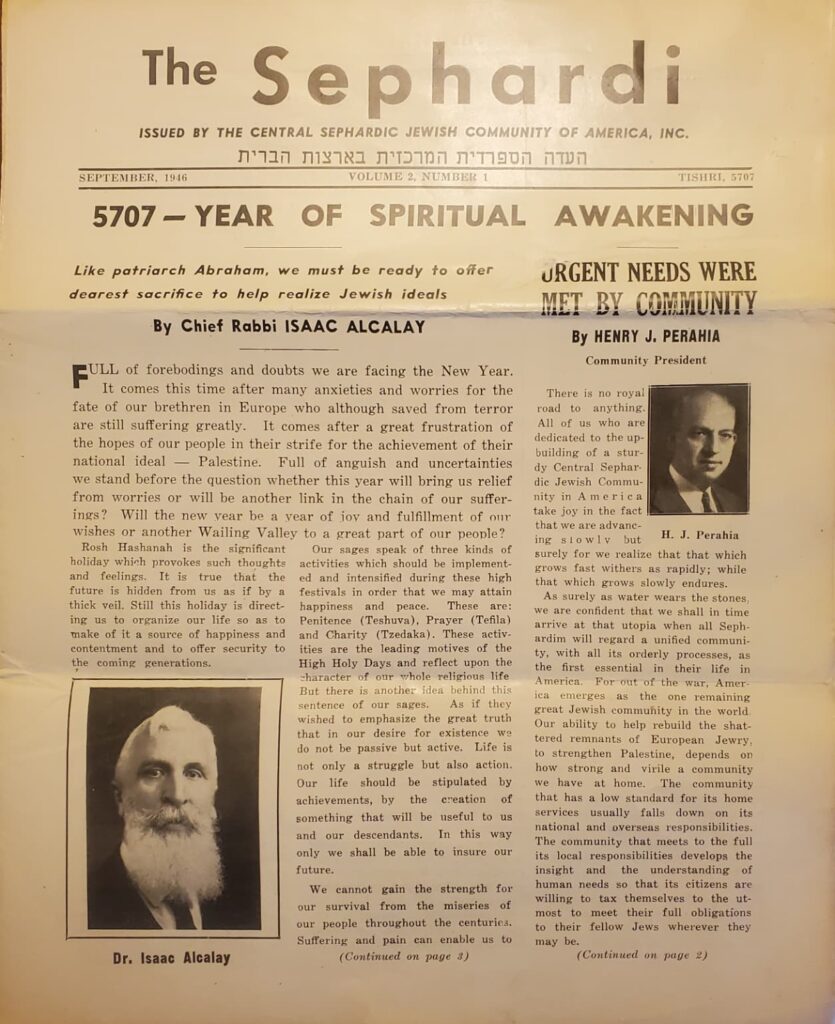
Writing in the wake of the Holocaust, the Chief Rabbi formerly of Yugoslavia and then of the American Sephardic community, Hakham Dr. Isaac Alcalay, approached the New Year 5707 (1946) with “broodings and doubts” about what the future might bring, especially in the land of Israel, but not about what needed to be done. “We cannot gain the strength for our survival from the miseries of our people throughout the centuries. Suffering and pain can enable us to resist, during a longer or shorter period, but cannot preserve us from extermination and destruction….” Instead, he challenges us to summon the courage of our ancestors to change “catastrophes” into “new creations.” Only in this way,
after the destruction of the first Temple[,] our people gave the world a book by which they earned the honorable name of the People of the Bible. After the fall of the Second Kingdom our people left to their descendants the great work of our oral law and tradition (Talmud). The persecutions of the Middle Ages brought about the intensification of the creative power of our people resulting in the best accomplishments in science, poetry and religious commentaries.
Today, we also witness an unprecedented catastrophe of our national life. Our epoch, with six million victims of the foe’s tyranny, can hardly be compared to any other period of Jewish persecution and suffering….
Almost 80 years later, we see the consequences of R’Alcalay’s conviction that positive achievements trump perpetual victimhood.
This year, instead of creating new days of mourning, especially since October 7th falls on Sukkot, let us multiply our mitzvot and merit a splendid Simchat Torah, the significance of which Hamas endeavored to snuff out along with its physical victims. As R’Alcalay concluded, “Let us be the worthy descendants of our great ancestors. Let us tighten our ranks and arise spiritually…. Let us intensify [our] sense of responsibility towards [our] people and humanity.” This heroic, classic Sephardic approach to life is necessary for building a future in which Jews are free to flourish and contribute to civilization.
Please join the American Sephardi Federation in advancing our purpose in the year ahead, from empowering new generations and strengthening Jewish unity to building bridges and celebrating the rich mosaic culture of the Greater Sephardi World. Your generous support will help us transform remembrance into renewal and renaissance.
Let’s not just fight antisemitism, but win… with Jewish joy, resilience, and pride!
Moadim L’Simcha,

Jason Guberman
Executive Director, American Sephardi Federation
~~~~~~~
The American Sephardi Federation invites all individuals, communities, and organizations who share our vision & principles to join us in signing the American Sephardi Leadership Statement!