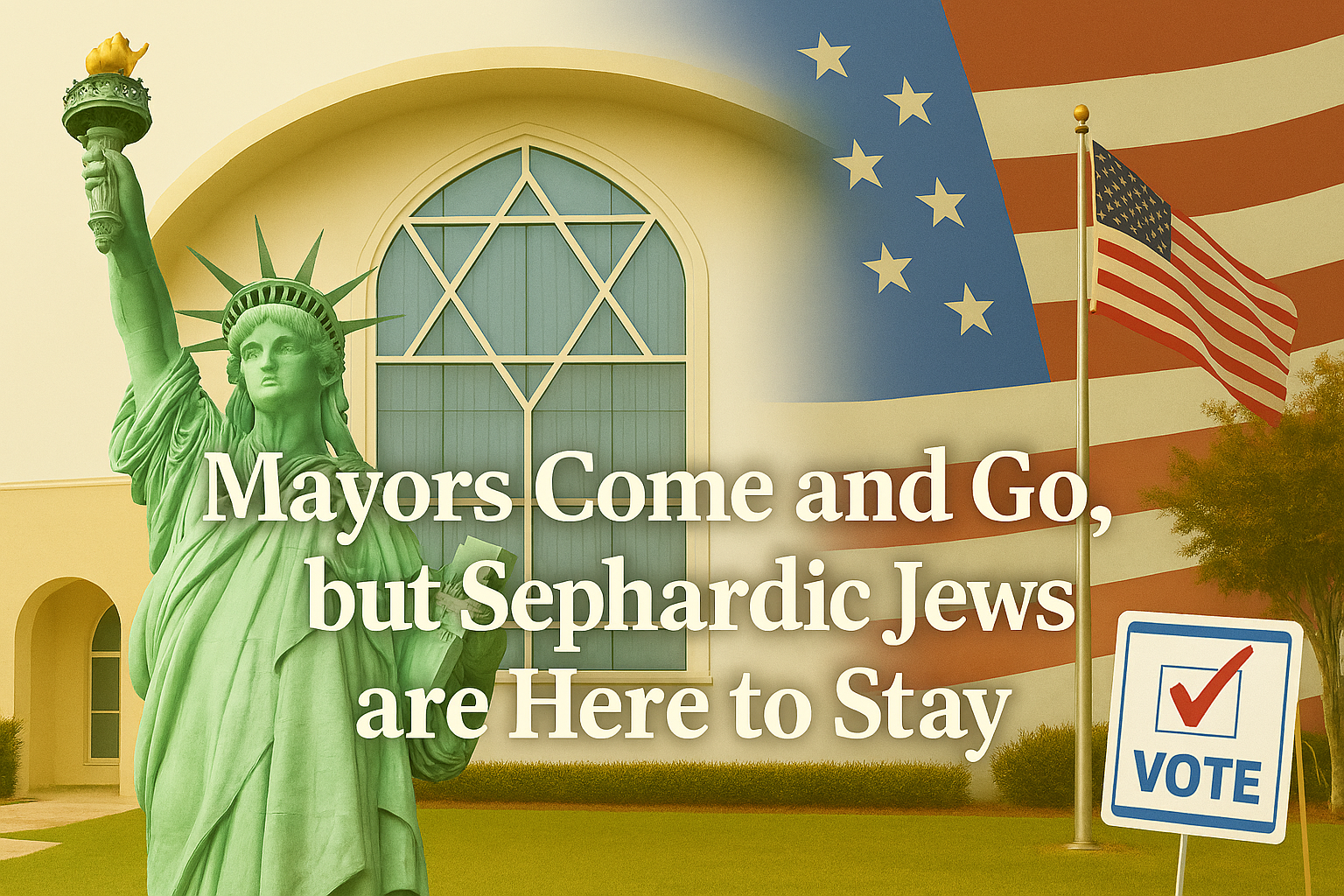
Mayors Come and Go, but Sephardic Jews are Here to Stay
Dear Friends,
Right before the High Holidays, I was interviewed by NPR about why flagship Brooklyn Syrian Sephardic institutions, Congregation Shaare Zion and the Sephardic Community Center, were requiring proof of voter registration to participate in services and programs. This wasn’t my first time on NPR or even talking about the Syrian community, but the stakes were different.
NYC is home to America’s first and, today, our country’s largest Jewish community, including many Jews hailing from various points in the Greater Sephardi diaspora, from Afghanistan, the Balkans, and Bukhara, to Greece, Iran, Iraq, Latin America, Morocco, Syria, and Yemen.
The issue of voter registration is especially charged because this is no ordinary election. Jews and Jewish issues have featured prominently, if not helpfully, in the campaign. Both Zohran Mamdani and Curtis Sliwa, the two endorsed major party candidates, have defended or doubled-down on statements and policies directed at Jews and Israel. Before dropping his re-election bid, Mayor Eric Adams showed off his Sephardic sartorial splendor at a Lebanese synagogue appearance on Rosh HaShanah, and was running on the “Safe & Affordable Party / End AntiSemitism Party” line.
A Sephardic voice, unfortunately, did not make the interview’s final cut. Instead, an Ashkenazi rabbi bemoaned how “terribly unusual” and “a little ludicrous” the requirement is (it isn’t, but more on that in a moment), an out-of-state professor “surmised” a partisan motivation, and a NYC Council Member-turned-Jewish-communal-leader cited public safety concerns. Herewith, let’s set the record straight and shed some light on the real stakes of this election.
Politicians come and go, but Sephardic Jews are here to stay. Indeed, the first Jews were in New Amsterdam a decade before it became “New York” and 122 years before the United States of America declared Independence. Upon arrival in 1654, 23 Sephardic Jewish refugees from Recife suffered Governor Peter Stuyvesant’s wrath, including the seizure and sale of their property, imprisonment, and threat of expulsion. When the latter failed, Stuyvesant sought to persecute the Jews by denying professional licenses, restricting their freedom to trade, and preventing them from serving with their fellow citizens on the communal watch.
Within a few years, thanks to the activism of Asser Levy and Jacob Barsimon, legal challenges mostly succeeded in defeating these antisemitic measures, securing Jewish civic and civil rights, as well as pioneering precedents for religious freedom that would set the stage for the miraculous founding of the USA as the first country in which Jews were granted full and equal citizenship.
Our constituents, American Sephardim, want their city, state, and country to succeed, especially by ensuring that all New Yorkers enjoy the political and economic freedoms that brought their forbearers to America, this land of opportunity, in the first place.
Jacob Abraham Dwek and Ezra Abraham Sitt are credited with being the founders of the Syrian Sephardic Jewish community in America. For more than 130 years since, SYs (the community’s nickname) have distinguished themselves through their entrepreneurship, compassion, and patriotic service. There is even a Syrian Piyyut set to the music of the Star-Spangled Banner!
It is more than a little ludicrous to have the community’s motives impugned and practices ostracized when participation in American civic life, just like observance of Thanksgiving, is a birthright thanks to American Sephardi patriots who have served and sacrificed in every generation for American liberty (See: “For God and Country: A Record of the Patriotic Service of Shearith Israel,” NY’s Spanish & Portuguese Synagogue).
Moreover, while Shaare Zion, the SCC, and others required registration, this is a far cry from certain Hassidic rebbes who endorse candidates and deliver blocks of votes like the Tammany Hall ward bosses of old.
By contrast and for too long NYC’s Greater Sephardic communities have been underrepresented both within the Jewish community and more broadly in civic life. The UJA-Federation of New York’s recent engagement, including significant support for Festival Sefarad, America’s first month-long, city-wide celebration of the Greater Sephardi World, represents a major step forward after a century of missed opportunities.
Thanks to the tremendous efforts of institutions requiring registration and activists powering registration drives, NYC’s Greater Sephardic communities are going to fully count regardless of what happens on Tuesday. We will finally have a seat at the table and be able to ensure that our concerns will be taken seriously.
American Sephardi Jewish New Yorkers are honoring the legacy of our forebears not by sitting on the sidelines, but by showing up and speaking out. The Sephardic Voice will be heard… in City Hall, if not yet on NPR.
“May there be peace within our walls,”
Jason Guberman
Executive Director, American Sephardi Federation
~~~~~~~
Please join the ASF in creating a great and glorious future where Jewish life is defined by what we achieve, not antisemitism!
~~~~~~~
Upcoming Events or Opportunities
Our friends at the Tribeca Synagogue in partnership with the American Sephardi Federation present:
Jewish Women in Film Festival
“TriBeCa Synagogue is proud to host the inaugural Jewish Women in Film Festival. Four evenings of cinema that celebrate stories told by extraordinary female Jewish filmmakers. This is more than a film festival — it is a gathering to inspire connection, conversation, and community”.
1-4 November 2025
@Tribeca Synagogue – 49 White Street, NYC
Sign-up Now!
Tickets: $10 in advance, $18 at door

~~~~~~~
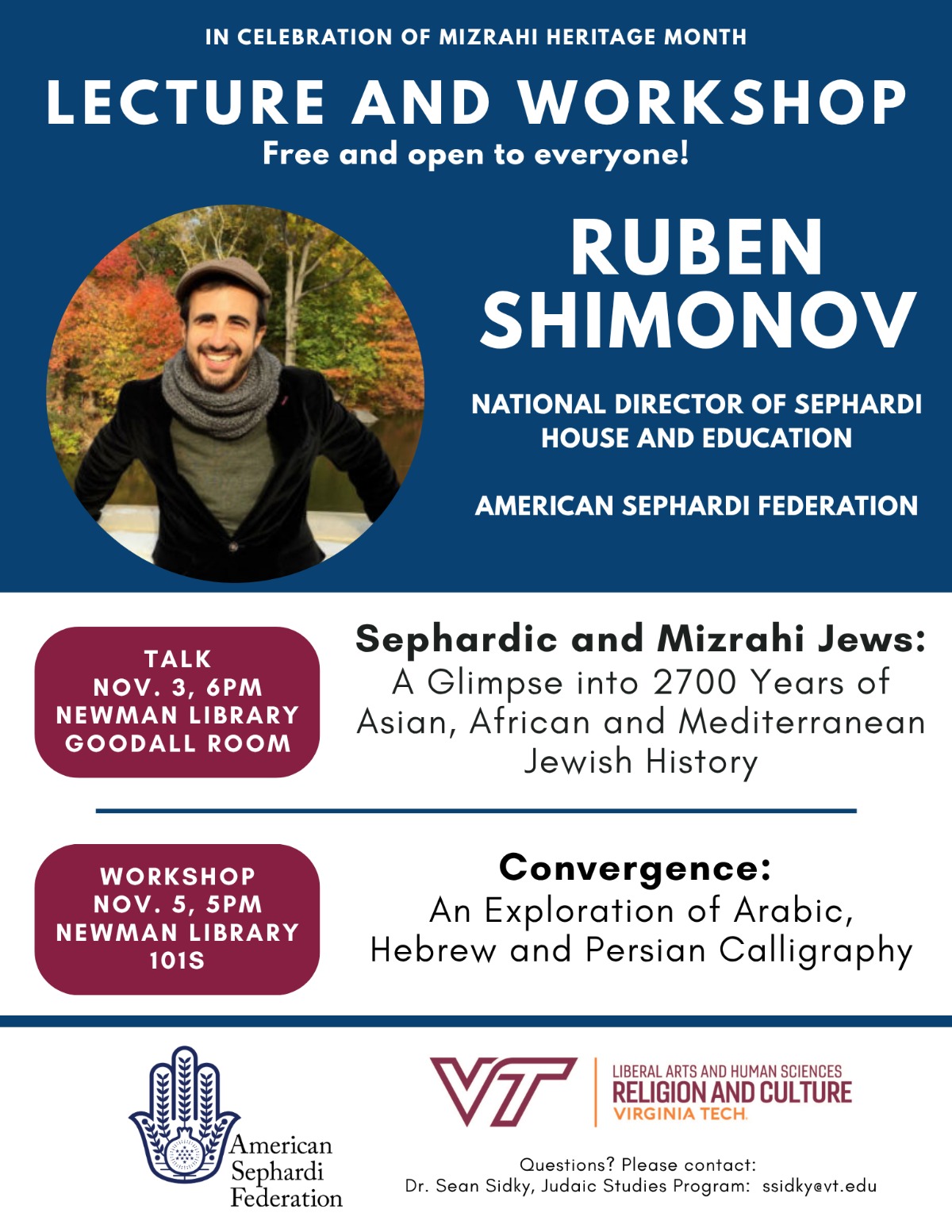
Our friends at Virginia Tech in partnership with the American Sephardi Federation in celebration of Mizrahi Heritage Month present:
Sephardic and Mizrahi Jews: A Glimpse into 2700 Years of Asian, African and Mediterranean Jewish History
“Join us for an introductory look at the rich tapestry of Sephardic and Mizrahi histories, cultures, and identities. Journeying through various time periods and geographical areas, we will deepen our knowledge of Jewish communities with deep roots in North Africa, the Mediterranean, the Middle East, and Central Asia. Our exploration will also shed light on the ways in which Sephardic and Mizrahi experiences fit into a broader conversation about Jewish history, diversity, and peoplehood”.
Monday, 3 November, at 6:00 PM ET
@Virginia Tech – University Libraries
Newman Library Goodall Room (MPR)
Tickets: Free and open to everyone!
Convergence: An Exploration of Arabic, Hebrew and Persian Calligraphy
“Join us as we dive into the rich visual worlds of Arabic, Hebrew and Persian calligraphy. Through historical, spiritual, linguistic and artistic lenses, we will discover the connections between these languages. Educator, community builder and artist Ruben Shimonov will also take us on an exploratory journey of his own multilingual calligraphy—sharing the ways he has used his art to build Muslim-Jewish interfaith bridges and celebrate the cultural diversity of the Greater Sephardi world. Participants will then have the opportunity to engage with these languages through a hands-on calligraphy workshop”.
Wednesday, 5 November, at 6:00 PM ET
@Virginia Tech – University Libraries
Tickets: Free and open to everyone!
About the speaker:
“Born in Uzbekistan, Ruben Shimonov is an educator, community builder, social entrepreneur, and artist passionate about Jewish diversity and intercultural understanding. He is the American Sephardi Federation’s National Director of Education & Sephardi House—an innovative initiative that works to enrich Jewish campus life and young leadership with the vibrancy, richness, and wisdom of the Sephardic and Mizrahi world. He is also the Founding Executive Director of the Sephardic Mizrahi Q Network. Previously, he was the Director of Community Engagement & Education at Queens College Hillel and Director of Educational Experiences & Programming for the Muslim-Jewish Solidarity Committee. As a visual artist, Ruben uses his multilingual Hebrew-Arabic-Persian calligraphy to build interfaith bridges and celebrate the diversity of the Greater Sephardi world. His art has been featured in international publications and exhibits, including at the U.S. Embassy in Uzbekistan. Ruben has brought his multilingual calligraphy workshops, as well as his lectures on Sephardic and Mizrahi Jewish histories, to conferences, universities, and museums around the world. He recently concluded an Artist Residency and Visiting Lectureship at the Tuohy Center for Interreligious Understanding at John Carroll University.”
~~~~~~~
Our friends at the Center for Jewish History in partnership with the American Sephardi Federation present:
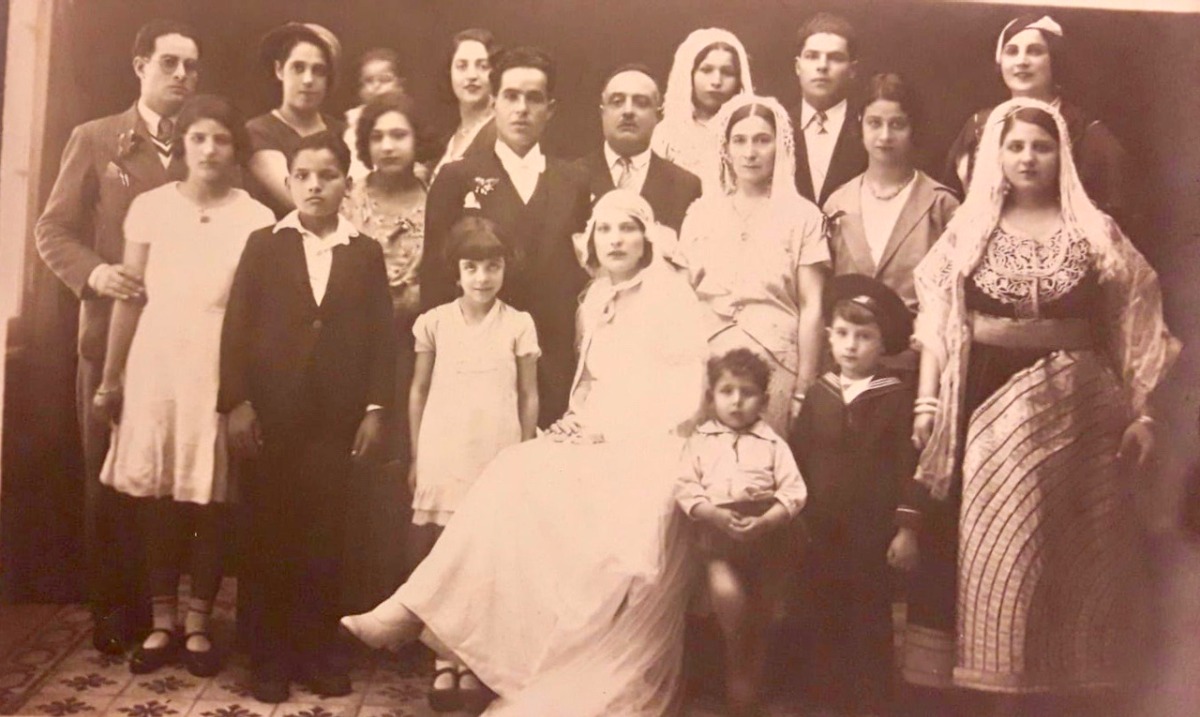
Family History Today: A Moroccan Jewish Genealogical Journey
“Join us for a fascinating talk with Raquel Levy-Toledano as she shares her remarkable journey to uncover the origins of her great-grandfather, born in Manchester. What began as a family mystery evolved into an international quest spanning Morocco, England, Portugal, the Azores, and Cape Verde, combining traditional archival research with genetic testing to reveal an unknown branch of her family—the Levy Belfsahi.
Along the way, Raquel connected with distant relatives around the world and shed light on the urgent need for more organized research on Moroccan Jewish genealogy. To help bridge this gap, she founded the Jewish Moroccan Genealogy group on Facebook, which now links over 400,000 profiles of Moroccan and Algerian Jews, reconnecting families and reconstructing a shared history.”
Monday, 3 November, at 5:00 PM ET
Sign-up Now!
Live on Zoom
Tickets: Pay what you wish – Free
About the speaker:
“Raquel Levy-Toledano was born in Morocco, then moved to France where she received her MD in gynecology and PhD in molecular endocrinology, followed by postdoctoral training at the NIH in Maryland. She is a board member of IAJGS, a board member of the Cercle de Généalogie Juive where she manages the Genetic Genealogy Group, a member of the General Assembly of the International Institute for Jewish Genealogy in Israel, president of NAJMA (Nos Ancêstres Juifs Marocains et Algériens) Genealogical Society, an expert curator of Geni’s Moroccan and Algerian Jewish family tree, co-administrator of the Avotaynu DNA project section involving North African Jews and founder of the Généalogie des Juifs Marocains Facebook Group, which has 13,000 members. She has published several articles in Généalo-J and other journals and has presented at numerous conferences and Zoom meetings.”
~~~~~~~
Our friends at Qesher in partnership with the American Sephardi Federation present:
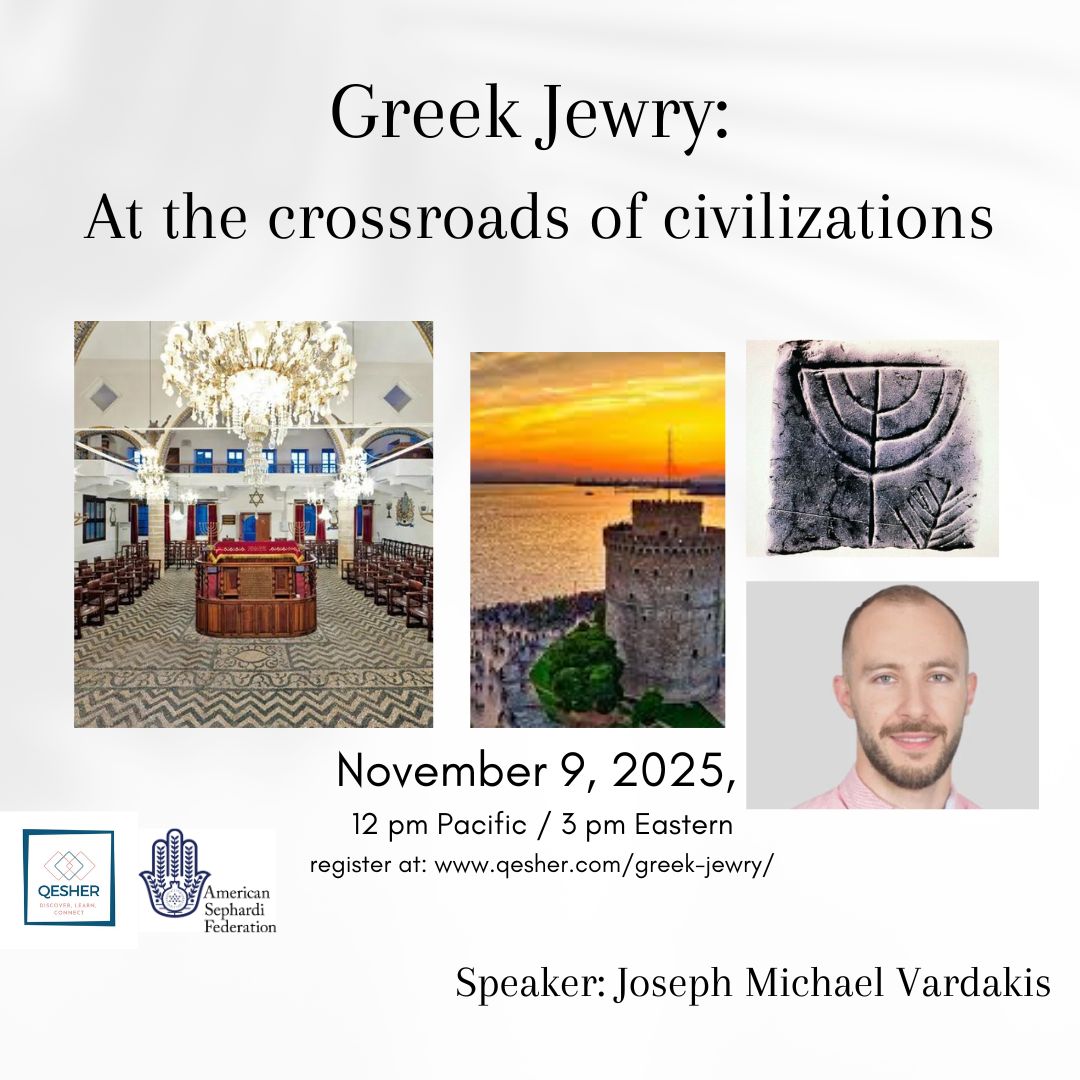
Greek Jewry: At the Crossroads of Civilizations
“The presence of Jews in Greece dates back to antiquity; it is one of the oldest Jewish communities in Europe, with a unique and multifaceted cultural heritage. Greece became a major center of Sephardi culture and was home to the distinctive Greek-speaking Romaniote community, as well as Jews who had taken refuge there from across Europe. On the eve of World War II, the Jewish population of Greece numbered around 80,000; however, the Holocaust decimated this community. Today, the Jewish community is working to preserve its remarkable heritage. In this exploration, we will delve into this ancient, diverse, and enduring Jewish culture that has spanned more than two millennia and continues to resonate in the modern era.”
Sunday, 9 November, at 3:00 PM ET
Sign-up Now!
Live on Zoom
Tickets: $18
About the speaker:
“Joseph Michael Vardakis was born in Athens, Greece. He has a B.A in Psychology, an M.A in Psychobiology and is currently completing his M.Sc in Clinical Psychology. He has lived and studied in the UK, South Africa and Israel and is currently residing in Athens. He has been a student counsellor for the Ministry of Absorption for new immigrants to Israel and has also worked in an educational framework for the Jewish community in South Africa before his studies. On his spare time, he offers themed tours in Athens, including sites of Jewish interest.”
~~~~~~~
Our friends at Qesher in partnership with the American Sephardi Federation present:
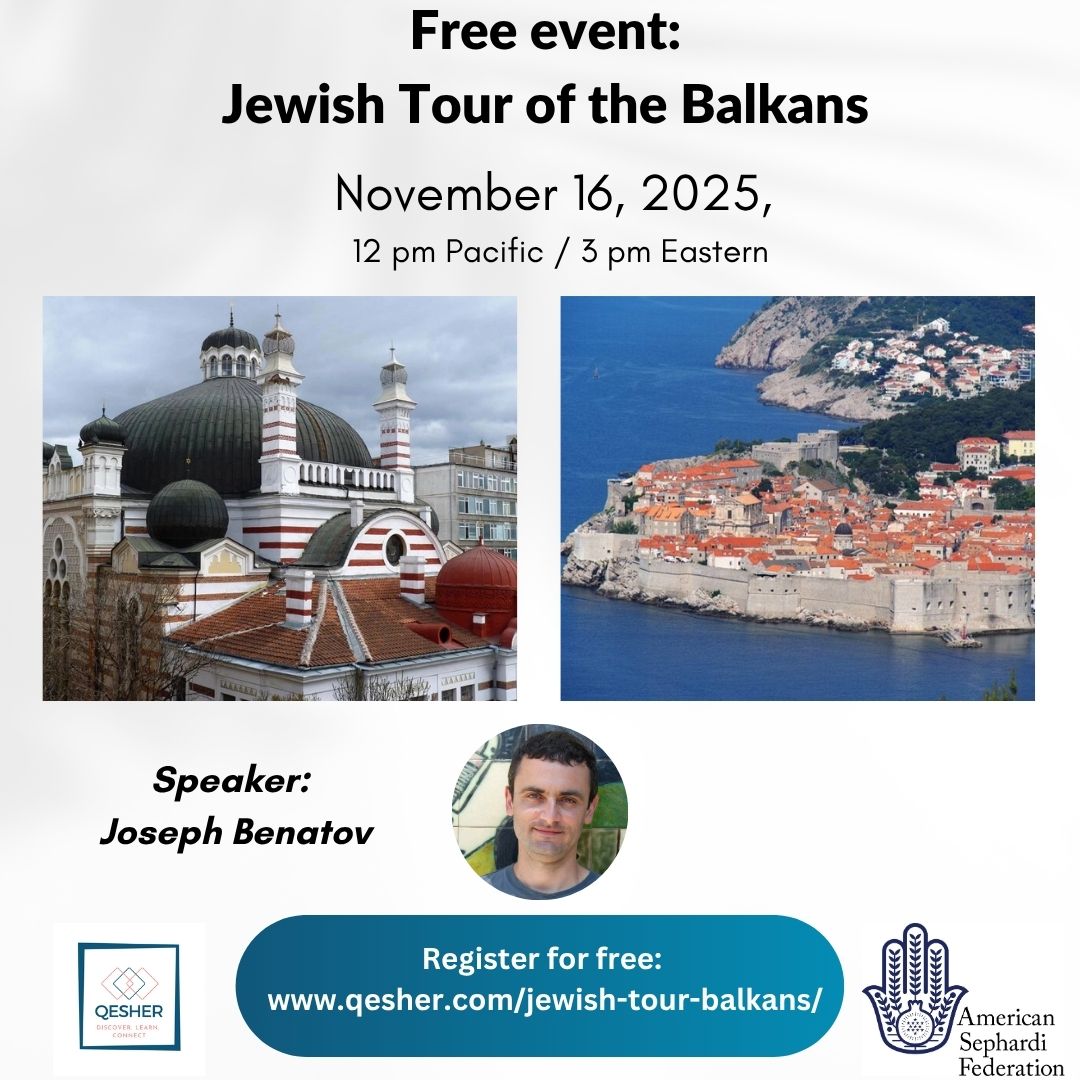
Jewish Tour of the Balkans
“Join us for a virtual tour through the rich Jewish history and culture of the Balkan peninsula. Learn about the Romaniote and Ashkenazi communities who inhabited the region. We’ll place particular emphasis on the Sephardic Jews of the Balkans who became the dominant Jewish community after 1492. We will highlight significant events and individuals from the Jewish history of Salonica, Sarajevo, Belgrade, Sofia, Dubrovnik, Bucharest, Zagreb, and Split. Find out about the Sephardic origins of proto-Zionism, the development of the Neo-Moorish architectural style, and the new Jewish holiday that Ottoman Sephardim invented in 1892.
In the second part of our meeting, we will present the annual Jewish heritage tours of the Balkans organized and led by Dr. Joseph Benatov of the University of Pennsylvania. Next year’s tour schedule includes the following trips:
Jewish Bosnia, Croatia, Slovenia, and Trieste (Italy) – May 2026
Jewish Romania, Serbia, and Szeged (Hungary) – May 2026
Jewish Montenegro, Albania, and Corfu (Greece) – May/June 2026
Jewish Bulgaria, North Macedonia, and Greece – June 2026”
Sunday, 16 November, at 3:00 PM ET
Sign-up Now!
Live on Zoom
Tickets: Complimentary
RSVP required
About the speaker:
“Joseph Benatov holds a Ph.D. in comparative literature from the University of Pennsylvania, where he teaches Hebrew. He is originally from Bulgaria and a member of Sofia’s Jewish community. Joseph has over 15 years of experience leading travelers across the Balkans, including UNESCO representatives, 92ndStreetY visitors, JDC board members, and Anti-Defamation League officials. He lectures regularly on the history of Jewish life in Bulgaria and on Balkan Sephardic culture. Every summer Joseph leads Sephardic trips to the Balkans.”
~~~~~~~
Our friends at Fed Tanour, Inc in partnership with the American Sephardi Federation and Sephardic Mizrahi Q Network present:
The Magic of Moroccan Song
Discover the Magic of Moroccan Song: A Hands-On Singing Workshop
“At this FED event, we’ll share the warmth and flavors of a traditional Moroccan Friday night dinner, for a full cultural and musical experience.
Join Dr. Yona A. Elfassi for a one-of-a-kind Moroccan singing workshop, the first of its kind at FED Talks! Together, we’ll dive into ‘Hiya Hiya,’ one of Morocco’s most beloved songs, telling the story of a woman in love. Through this song, we’ll:
- Explore how love and desire are expressed in Moroccan music
- Unpack the lyrics and their cultural context
- Sing together in Moroccan Arabic
- We’ll also share a delicious homemade Moroccan Shabbat dinner!
No prior knowledge of Moroccan Arabic is required – just bring your voice, curiosity, and an open heart.
Get ready to sing, connect, and fall in love with the rhythms and stories of Morocco!”
.
Sunday, 16 November, at 6:30 PM ET
@Manhattan
(exact address will be provided upon registration).
Sign-up Now!
Tickets: $50 (Includes singing workshop and Shabbat dinner)
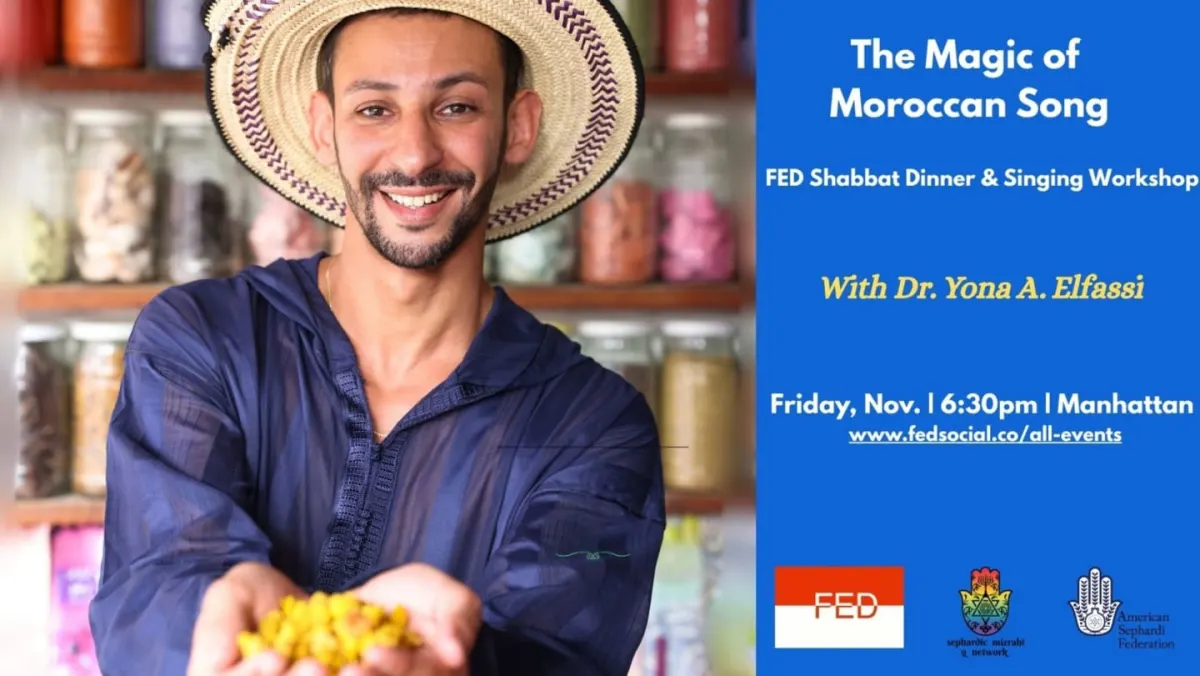
About the speaker:
“Dr. Yona A. Elfassi is a Moroccan-born educator, researcher, and content creator whose work bridges cultures, disciplines, and continents. He has been based in Israel for the past decade. He holds a dual PhD in Middle East Studies (Ben-Gurion University, Israel) and Sociology/ Anthropology (Sciences Po Bordeaux, France). Yona’s work has taken him around the globe, where he has been invited to lecture at leading universities and institutions. His academic journey transcends traditional boundaries, driven by a belief that research should also build connections and foster understanding. Beyond academia, he amplifies his impact through social initiatives, public engagement, and creative storytelling, including short films. Dedicated to exploring the complexities of Muslim-Jewish relations, the plurality of identities, and the preservation of indigenous cultures, Yona’s mission is to generate knowledge that inspires dialogue, empathy, and meaningful change across communities”.