Uniting East and West: An Israeli Musical Dream
24 November 2025
Félicitations/Mazal Tov to Philippe Aghion, one of three recipients of the 2025 Nobel Prize in Economics! Aghion spoke at the ASF’s 26th NY Sephardic Jewish Film Festival.
Click here to dedicate a future issue in honor or memory of a loved one

Upcoming Events ◊ ASF Sephardi Shop ◊ Sephardi World Weekly ◊ ASF Sephardi House ◊ Archive◊ Donate
The American Sephardi Federation’s Sephardi Ideas Monthly (SIM) by Dr. Aryeh Tepper is a continuing series of essays and interviews from the rich, multi-dimensional world of Sephardi thought and culture that is delivered to your inbox every month.
————————————
This month’s issue of Sephardi Ideas Monthly introduces a new mini-series, “Uniting East and West: An Israeli Musical Dream”
Uniting East and West: An Israeli Musical Dream
The return of sovereignty to the Jewish people in the land of their ancestors is an event without historical parallel or precedent. Never before has the world seen a dispersed nation reassemble in its ancestral homeland after 2,000 years and reacquire political power.
But the political rebirth of the Jewish people is downright superficial compared to the deep cultural exchange that informs and animates life in the modern state of Israel. The traditional expression for the robust cacophony of voices that fills the Israeli soundscape is “the ingathering of the exiles.” The phrase retains its ancient power, reflecting the wide range of exilic Jewish cultures and the aspiration to connect the best of those cultures in the emergent national soul. After two thousand years of separation, Jewish communities that fled to the East and to the West and speak “seventy languages”—a traditional number parallel to “the seventy nations of the world,” symbolizing Israel as a multi-cultural microcosm of humanity—meet again. It would have been uncanny if Jewish communities from around the globe reconvened after two thousand years, say, in Uganda. But for the uncanny meeting to take place in the land of our ancestors, just as the people dreamt, and the prophets guaranteed? The mind begins to bend.
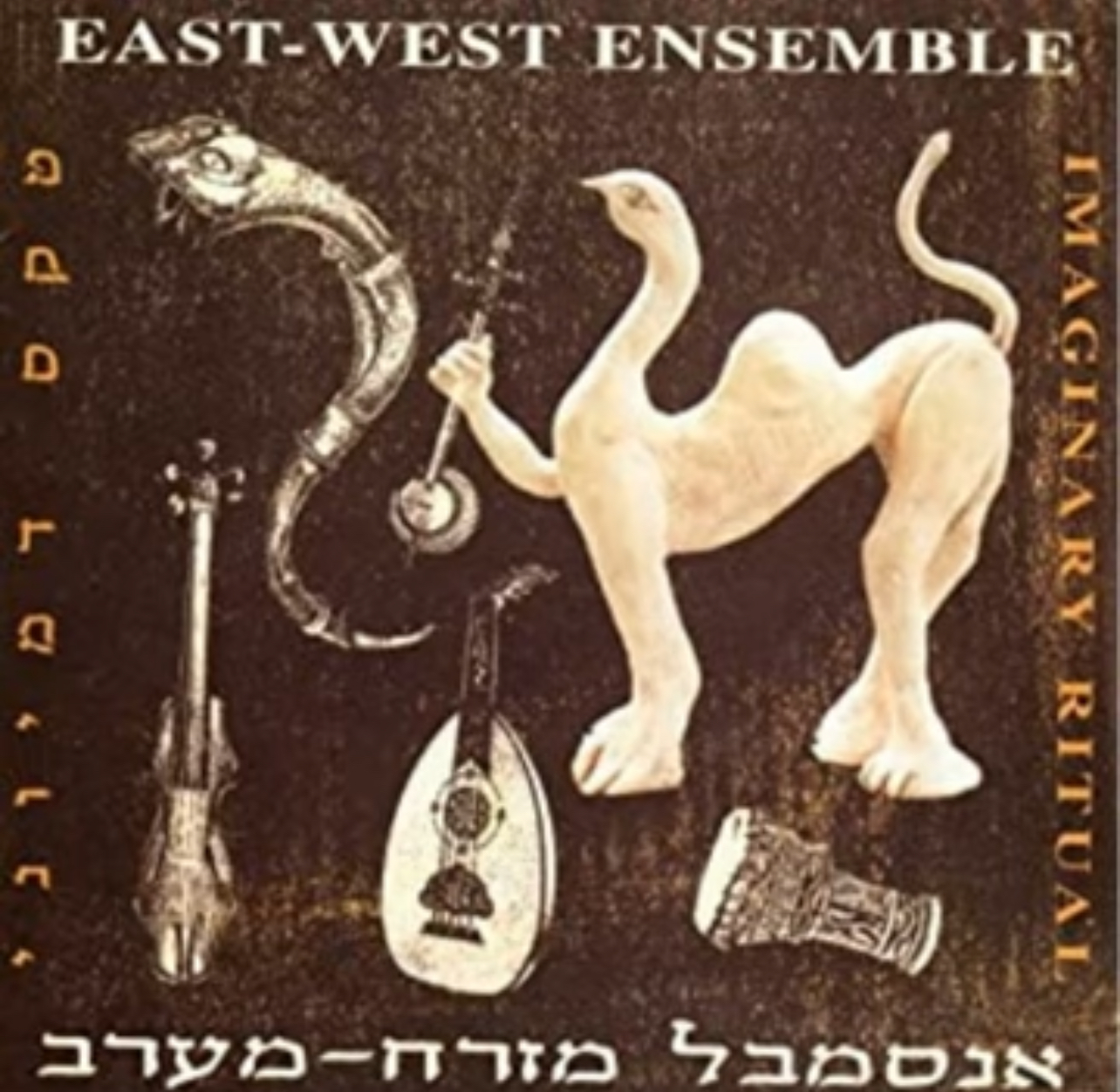
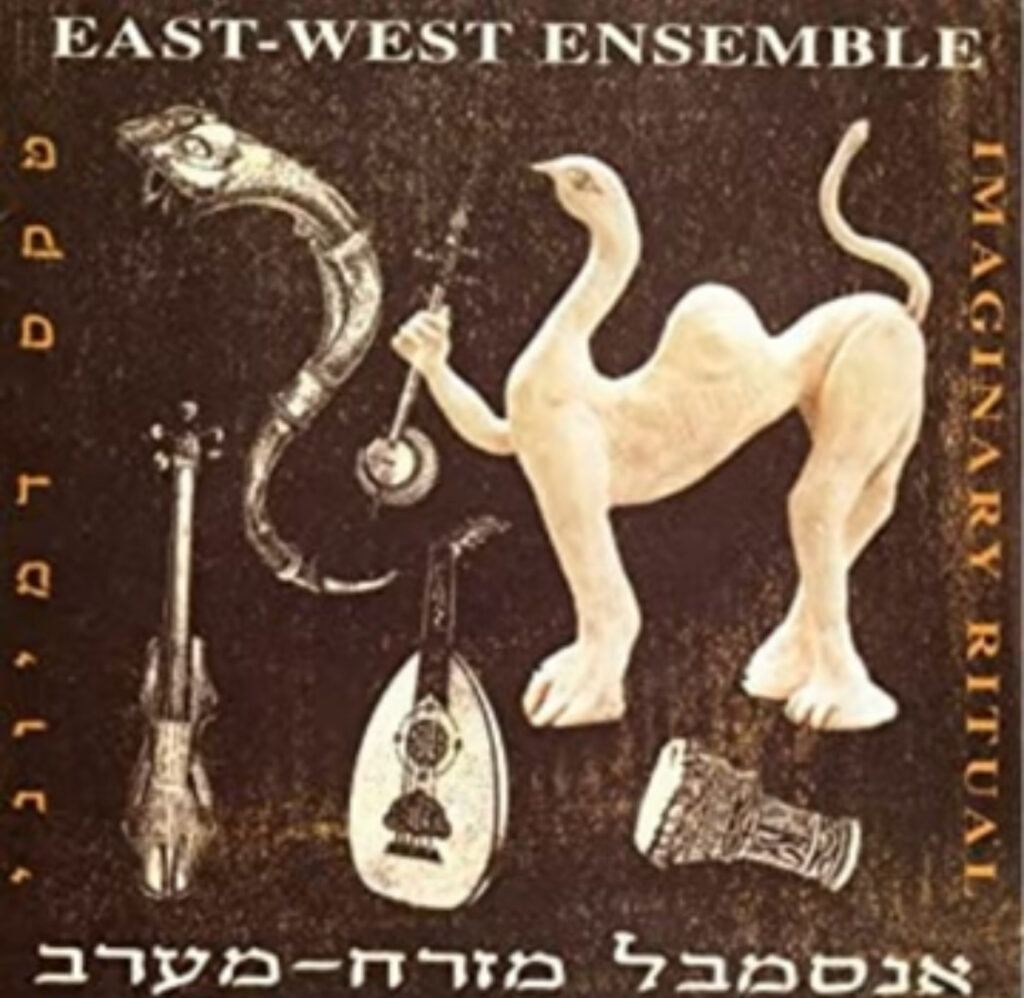
The dream of “the union of East and West” accordingly has been a recurring theme and powerful leaven across the history of Israeli culture, especially Israeli music. The most famous example is Boaz Sherabi’s 1986 pop song, “Halavai” (“If only…”), and its wish for “East and West to merge together.” But only one year before Sherabi’s hit, Yisrael Borochov, a pioneer of Israeli “Ethnic Music,” integrated Eastern and Western musical forms and orchestration in his “East-West Ensemble.” Borochov later opened the “East-West House” in Jaffa, a unique musical performance space that remains active today. Meanwhile, one of Israel’s two Andalusian orchestras is named “Jerusalem Orchestra: East & West,” while Jerusalem hosts its own “East & West Festival.” And so on.
This pining for the uniting of East and West in Israeli music reflects the basic fact that, culturally speaking, Israel is not part of the East, nor part of the West. To reduce Israel to one side cuts the nation off from sources of life that have been transmitted across generations. In Israel, both East and West are part of Israel’s national soul.
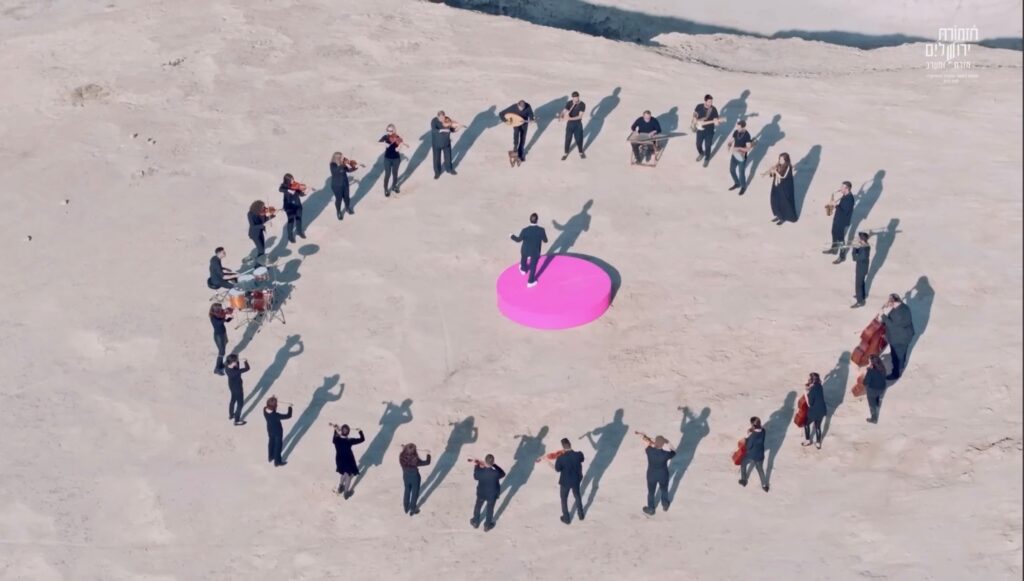
In this video recording of the Arabic Hisa bi (“Feel Me”), staged in the middle of the Negev desert, Tom Cohen’s “Jerusalem Orchestra: East & West” blends classical Western strings, brass, and woodwinds with the Eastern oud, qanun, darbuka, bendir, and frame drums, while anchoring all of the sounds in a steady backbeat
Yisrael Borochov leads “The East-West Ensemble” in an exuberant performance of Borochov’s original, “Daud’s Celebration,” with bass harmonies branching out into rich patterns beneath the Zurna-propelled melody, while the ensemble gives soloists plenty of space for improvisation
East and West in the Pre-State Period
The need to navigate and the desire to integrate “East and West” can be traced back to leading composers and musicians in the pre-State period, before 1948. The celebrated Israeli musicologist, Yehoash Hershberg, framed “The Vision of the East and the Heritage of the West” as a tension that has characterized Israeli music from its inception.
The terms “East and West” need to be used with a certain looseness of expression. By the 1930s, a majority of Jews from various points in Europe and Russia had joined communities of Moroccan, Yemenite, Syrian, Iraqi and Bukharian Jews in the Land of Israel, together with the old Sephardi communities of Ottoman Jerusalem and Tiberius. “East and West” thus came to indicate the medley of manners, mores, songs and dishes that, until today, punctuates Iocal life with a distinction between Jewish cultures from the lands of Christendom and the lands of Islam.
According to Hershberg, most pre-state composers and musicians found themselves somewhere along a continuum between two ideological poles: a “Vision of the East” that rejected the European musical past and turned to the East as a source of inspiration and renewal, and the “Heritage of the West” that celebrated the rich Western heritage of musical training.
Another celebrated Israeli musicologist, Amnon Shiloach, revisited the meeting of East and West in a 1989 lecture, “‘And Toward the East, Forward’: On the Integration of Eastern Elements in Israeli Music” (in Hebrew). Shiloach’s title borrows from Naftali Herz Imber’s 19th-century poem that later became Israel’s national anthem, HaTiqvah, “As long as the heart within the Jewish soul yearns toward the East, forward, an eye looks to Zion.”
While the idea of turning “toward the East” inspired composers and musicians during the pre-state period, Shiloach distinguishes between a turn to the East that is primarily a flight to a romantic ideal, and the kind of openness and receptivity that listens to and absorbs the life and sounds actually found in the Land, and the region. Shiloach notes that during the pre-state period there were those who consciously sought to synthesize contemporary Eastern and Western musical elements. A notable example of this tendency is the collaboration between Bracha Tzfira, a charismatic singer with knowledge of a vast repertoire of Eastern Jewish and Arabic music, and her classically-trained musical and life partner, Nachum Nardi.
Bracha Tzfira and Nachum Nardi: Yesh Li Gan (“I Have a Garden”)
Bracha Tzfira (1910–1990) is a legendary figure in the history of Israeli culture. The first of a long line of Yemenite-Jewish vocalists who have occupied a disproportionally prominent place in Israeli music, Tzfira was orphaned at a young age and raised by Sephardi foster families in pre-state Jerusalem, where she absorbed diverse Jewish and Middle Eastern musical traditions. Her vocal talent was recognized early, and she performed extensively for Jewish audiences at home before leaving to study in Berlin in 1929, where she met the man who would become her musical partner and, for a time, husband, Nachum Nardi.
The Kiev-born Nardi (1901-1977) was trained as a pianist and composer at the Kiev, Warsaw, and Vienna conservatories. After graduating with honors and performing Western classical music across Europe, Nardi made Aliya to the land of Israel in 1923. He was on a European tour accompanying violinistMoshe Weisbord when he met Tzfira at Berlin’s Jewish community center. Soon, Nardi was accompanying Tzfira’s performances.
The collaboration between Tzfira and Nardi continued upon their return to pre-state Israel, and it was groundbreaking. Nardi’s arrangements and piano accompaniments to Tzfira’s repertoire of Yemenite and pan-Sephardic folk songs, sung in her distinct Yemenite vocal style, helped to create the genre of Hebrew music in the early Israeli soundscape.
An excellent example of the fruitful collaboration between Nardi and Tzfira is the song Yesh Li Gan (“I Have a Garden”), with lyrics written by Israel’s “national poet,” Hayim Nahman Bialik. The melody for “Yesh Li Gan” was adapted from a song composed by the Egyptian singer-composer Sheikh Muhammad ‘Abd al-Rahim al-Maslub, to which Tzfira added her Yemenite stylistic ornamentation. Nardi accompanied on piano with Western harmonies and modal melodic lines. Note: Tzfira and Nard did not limit themselves to Jewish sources. Being artists with particularly strong receptive capacities, they were open to the music of the local soundscape, which of course included Arabic music of various kinds. The final musical product that implicitly links al-Maslub to Bialik in Yesh Li Gan is a good example of the artful blending of sonic worlds that Nardi and Tzfira brought to the music scene of the pre-state community.
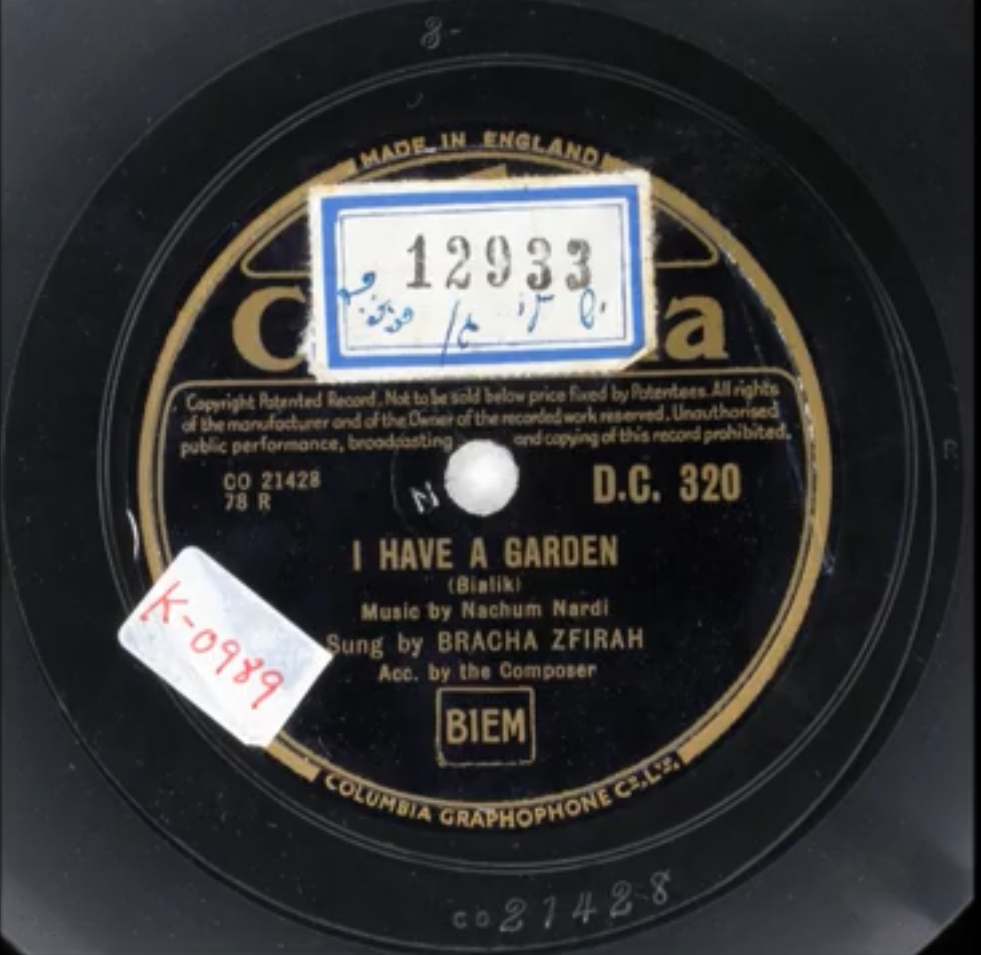
There are many versions of Yesh Li Gan available today. The most iconic is a 78 rpm Columbia Records release from 1937 with Tzfira’s vocals and Nardi’s arrangement and accompaniment. Other noteworthy performances and recordings include another vocalist in the long of Yemenite-Jewish Israeli singers, Ofra Haza, who recorded and performed a rendition of the song in the early 1980s featuring elegant vocals over a light rhythm, while Israeli jazz lion Daniel Zamir offered his own turbo-charged interpretation in 2002 on John Zorn’s “Tzadik” label. Video recordings can be found below:
In this 1937 recording, Bracha Tzfira and Nahum Nardi collaborate on the original version of Yesh Li Gan, with Tzfira’s melismatic phrases and clear diction dressing the original Arab melody ‒ not a ‘traditional Syrian’ melody, per the video’s title ‒ in the lyrics of Bialik’s poem. Nardi elegantly accompanies on piano with Western classical harmonies and modal melodic lines:
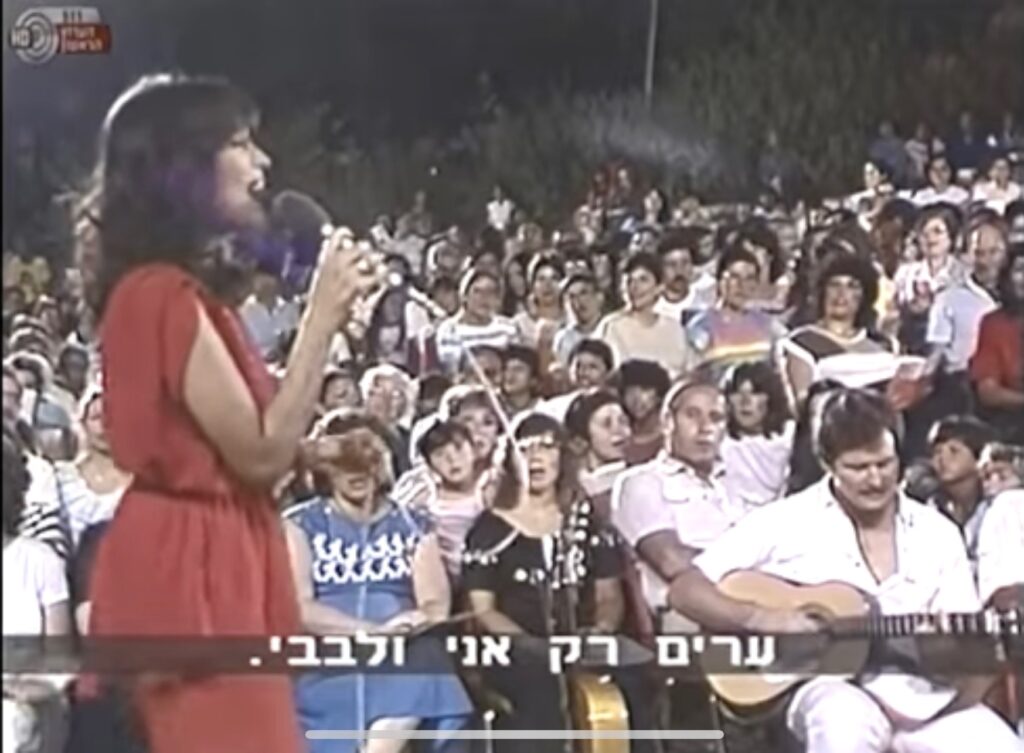
In this video recording from a 1983 public sing-along, Ofra Haza offers an updated version of Yesh Li Gan, with her elegant Yemenite inflected vocals sung over a gentle rhythm in a moderate, flowing tempo:
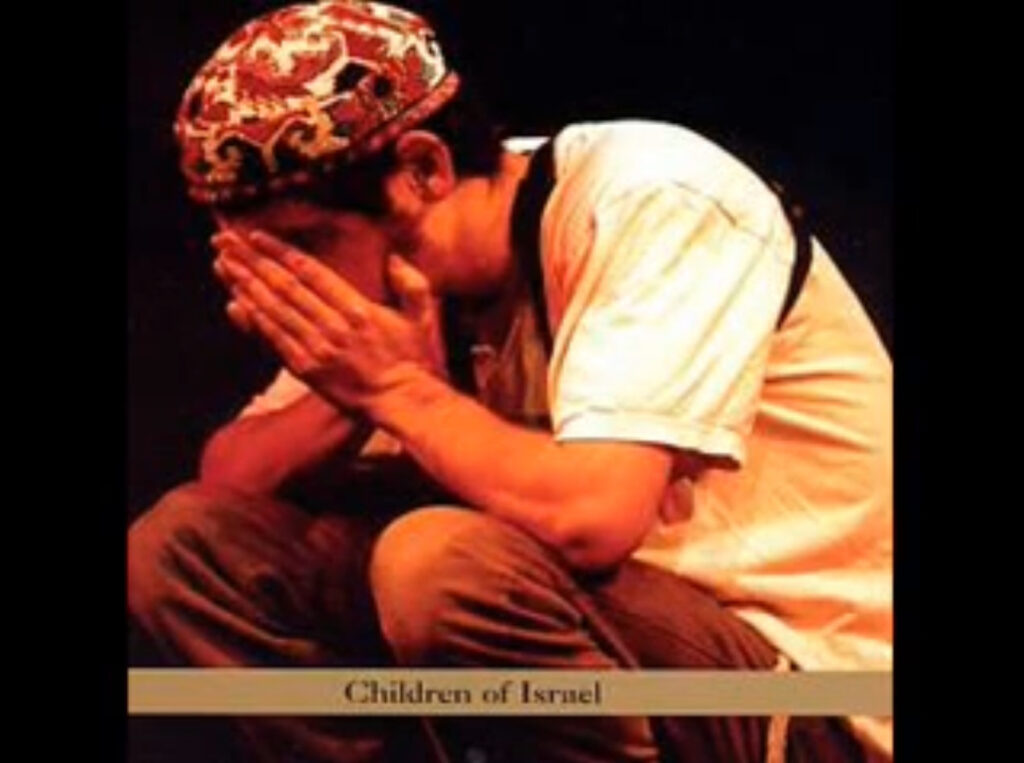
In this 2002 recording, Israeli jazz lion, saxophonist Daniel Zamir, extends and elaborates Yesh Li Gan as an improvisational workout supported by layered wind textures and syncopated percussion, with subtle polyrhythms driving the groove:
~~~~~~~
A Pizmonim: Sephardic-Hebrew Songs of the Middle East, Volume 1
By David Elihu Cohen
Pizmonim, a unity of poetry and song, have been an integral part of the Jewish People and may be traced in the Bible to the very beginning of our history.
The twelve selected Pizmonim contained in this booklet serve to perpetuate the Greater Sephardic culture and tradition of singing praise to the Lord on all joyous occasions.
Matzah and Flour: Recipes from the History of the Sephardic Jews
by Dr. Hélène Jawhara Piñer
A collection of 125 meticulously crafted recipes showcasing the enduring flavors that define Sephardic culinary heritage.
Matzah and Flour: Recipes from the History of the Sephardic Jews offers a tantalizing exploration of the central role of matzah and flour in Sephardic cuisine. Journey through centuries of tradition as flour, from various grains like chickpea, corn, and barley, intertwines with cultural narratives and religious observance. Delve into the symbolism of matzah, from its origins in the Exodus story to its embodiment of resilience and identity. Each of this cookbook’s thoughtfully prepared recipes is a testament to the transformative power of flour in Sephardic culinary heritage. From savory delicacies to sweet delights, these timeless flavors have sustained Sephardic families through history. Matzah and Flour is a celebration of tradition, history, and the enduring legacy of Sephardic Jewish cuisine.
~~~~~~~
Upcoming Events or Opportunities
Our friends at The Habura present:
Members Online Series
Hegyonei Uziel
An Introduction to Rabbi Uziel’s Rooted Cosmopolitan Judaism
“Join Dr. Aryeh Tepper for a three-part exploration of Hegyonei Uziel, the culminating work of Rabbi Ben-Sion Meir Hai Uziel 1880-1952), will examine R. Uziel’s on the soul, Torah generations, the e sessions 1, and suffering, revealing
the foundations of his Rooted Cosmopolitan Judaism, and to arouse interest in a group that will learn the book, lishma.”
Sundays at 2:00PM EST
30 November
7 December
Members Access Here

~~~~~~~
Our friends at Magen David Sephardic Congregation in partnership with the American Sephardi Federation present:
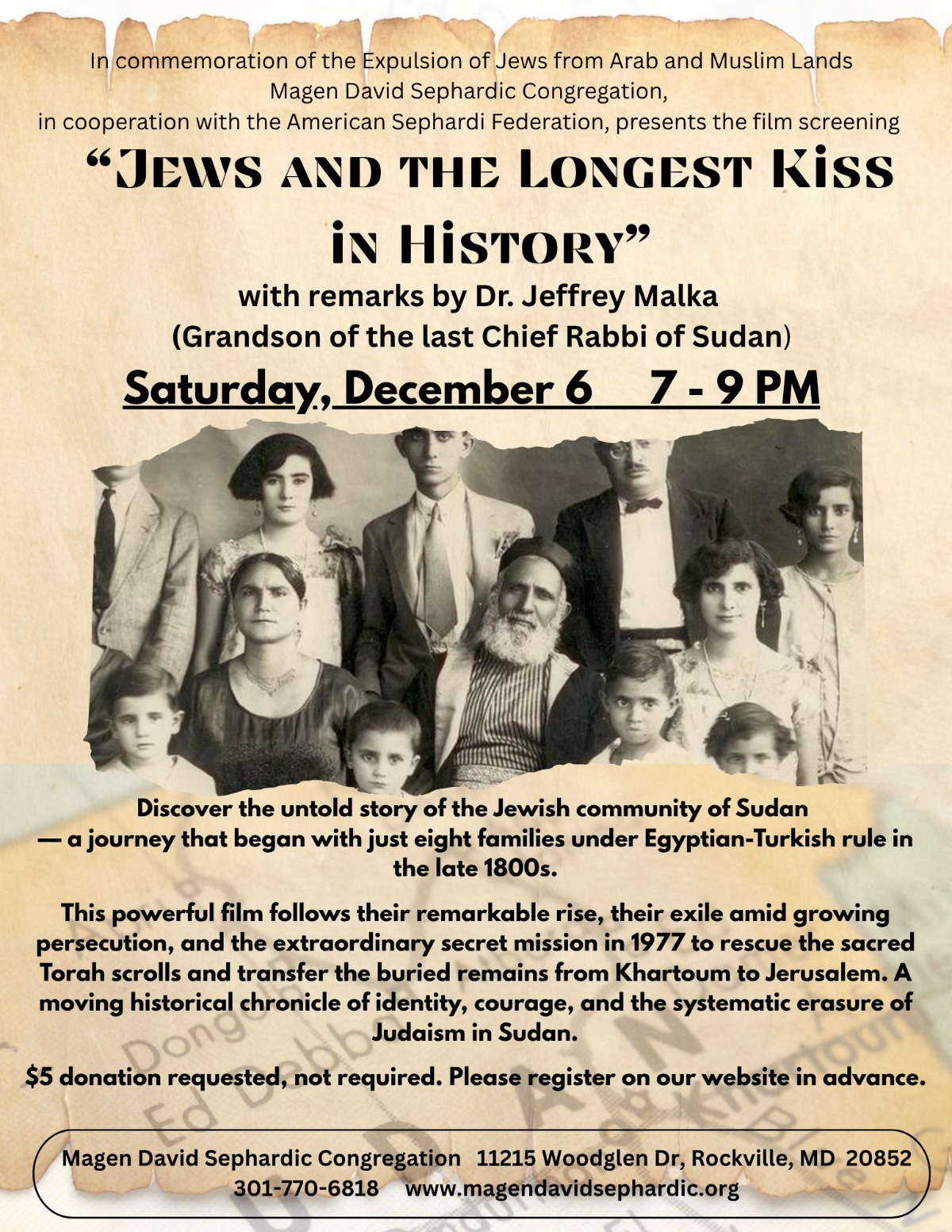
Jews of Sudan; A Film Screening
“Jews and the Longest Kiss in History”
With remarks by Dr. Jeffrey Malka
(Grandson of the last Chief Rabbi of Sudan)
In commemoration of the Expulsion of Jews from Arab and Moslem Lands
“Discover the untold story of the Jewish community of Sudan— a journey that began with just eight families under Egyptian-Turkish rule in the late 1800s.
This powerful film follows their remarkable rise, their exile amid growing persecution, and the extraordinary secret mission in 1977 to rescue the sacred Torah scrolls and transfer the buried remains from Khartoum to Jerusalem. A moving historical chronicle of identity, courage, and the systematic erasure of Judaism in Sudan.”
Saturday, 6 December 2025, 7:00 PM – 9:00 PM EST
@Magen David Sephardic Congregation
11215 Woodglen Dr, Rockville, MD 20852
Sign-up Now!
Tickets:
Complimentary ($5 Donation requested, not required)
RSVP required
~~~~~~~
The American Sephardi Federation with the Sephardic Foundation on Aging proudly presents:
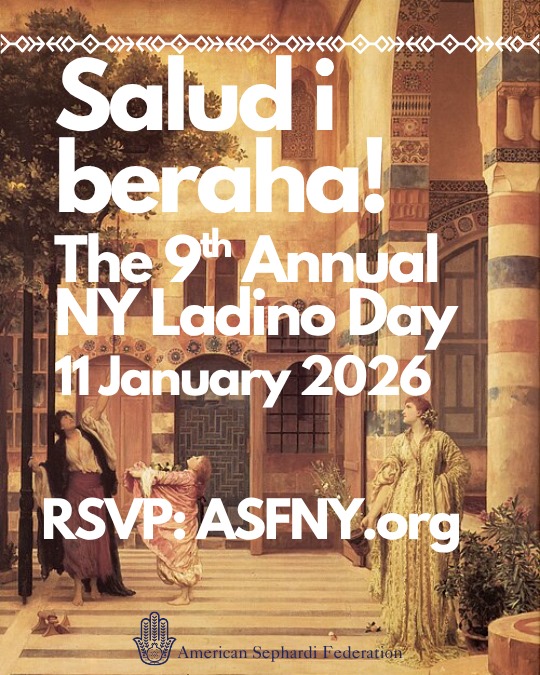
Salud i beraha: The 9th Annual NY Ladino Day!
Curated by Jane Mushabac and Bryan Kirschen
- Musical Performance featuring Brazilian Ladino singer Fortuna, accompanied by her quartet
• Keynote Speaker Dr. Joe Halio
Sunday, 11 January 2:00-5:00PM EST
In-Person @ the Center for Jewish History
15 W 16th Street, New York City
Full program details will be announced soon.
Sign-up Now!
Early Bird Tickets:
$20 Early Bird General Admission
(Admission to Ladino Day)
$30 Friend of NY Ladino Day
(Includes a copy of the book: The Historic Synagogues of Turkey, and admission to Ladino Day)
$50 VIP Friend of NY Ladino Day
(Includes VIP reception prior to the program, a copy of the book: The Historic Synagogues of Turkey, and VIP seating at Ladino Day)
*Early Bird prices end on 1 December 2025
Since 2013, Ladino Day programs have been held around the world to honor Ladino, also known as Judeo-Spanish. January 11th marks New York’s 9th Annual Ladino Day hosted by the American Sephardi Federation.
Ladino is a bridge to many cultures. A variety of Spanish, it has absorbed words from Hebrew, Turkish, Arabic, French, Greek, and Portuguese. The mother tongue of Jews in the Ottoman Empire for 500 years, Ladino became the home language of Sephardim worldwide. While the number of Ladino speakers has sharply declined, distinguished Ladino Day programs like ours celebrate and preserve a vibrant language and heritage. These programs are, as Aviya Kushner has written in the Forward, “Why Ladino Will Rise Again.”
Postcard: Frederic Leighton’s “Old Damascus: Jew’s Quarter (Gathering Lemons),” c.1873-1874
Please support New York Ladino Day with a generous, tax-deductible contribution to ASF so we can continue to cultivate and advocate, preserve and promote, as well as educate and empower!
Donate Now to Support NY Ladino Day!
Sponsorship opportunities available: