In Memory of Claude Cohen-Tannoudji, A”H, a Constantine-born French Sephardi scientist who won the Nobel Prize in Physics (1997) for developing a method for making atoms more amenable to study. Cohen-Tannoudji (meaning “from Tangier”) credits his cosmopolitan yet seriously Jewish background with inspiring his pursuit of “learning and sharing knowledge with others.”
Click here to dedicate a future issue in honor or memory of a loved one
Upcoming Events ◊ ASF Sephardi Shop ◊ Sephardi World Weekly ◊ ASF Sephardi House ◊ Archive ◊ Donate
The American Sephardi Federation’s Sephardi Ideas Monthly (SIM) by Dr. Aryeh Tepper is a continuing series of essays and interviews from the rich, multi-dimensional world of Sephardi thought and culture that is delivered to your inbox every month.
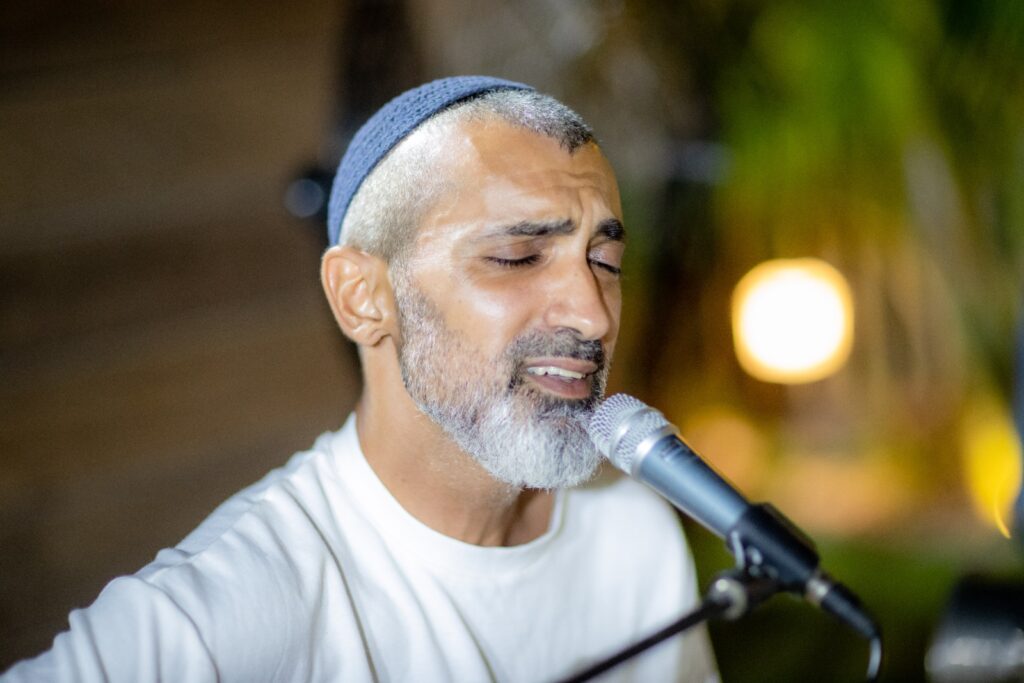
Ziv Yeḥezqel is a leading paytan of his generation, a singer of liturgical “soul” music rooted in the Jerusalem-Sephardi tradition and its Syrian, Egyptian, and Iraqi musical lineages. He shapes Hebrew and Arabic with precision, bringing their sound, syntax, and layered meanings into a microtonal practice of unusual control. Yet technique alone cannot explain Yeḥezqel’s artistic force. His emotionally charged, rhythmically intricate improvisations grow from rigorous apprenticeship and a drive to renew inherited forms. Continuing the work of Rabbi Haim Louk, the master paytan of the previous generation, Yeḥezqel has brought the paytan’s art to new concert stages. Most recently, he appeared as a featured vocalist in Yagel Haroush’s reimagining of Keter Malchut, Rabbi Shlomo ibn Gabirol’s monumental poetic meditation on divine sovereignty and the human soul.
Born in Kiryat Ono in 1984, Yeḥezqel is the son of an Iraqi Jewish father and a Moroccan Jewish mother. When he was three, his parents became religious amid the Sephardi revival associated with “Shas.” Emerging in the 1980s as a religious, political, and social movement, Shas gave many Israelis whose families had emigrated from Arab and Islamic lands religious institutions, political representation, and a historical narrative that challenged the assumption that their family histories began with migration and the transit camps. In Yeḥezqel’s case, that return also opened access to the piyut traditions through which Arabic modal practice entered and took root in synagogue life.
Yeḥezqel studied in Sephardi Haredi schools and yeshivot in Bnei Brak and Jerusalem, institutions serving Sephardi students but shaped by Lithuanian Haredi curricular and institutional norms. At thirteen, he began serving as a congregational paytan. Three years later, an oud sounded through a yeshiva dormitory wall and changed the course of his life. He learned classical Arabic from cassettes, worked through Umm Kulthum and Abdel Waheb phrase by phrase, and practiced seven to ten hours a day. Through that repertoire, he learned tarab, an art in which words, melodic development, rhythm, and the singer’s relation to the room generate a deeply shared feeling. He has since performed Arabic classical repertoire with the Nazareth Arab Music Orchestra, the Jerusalem Orchestra East and West, and the Israeli Andalusian Orchestra Ashdod. In Jerusalem, he also founded a school where aspiring paytanim study the maqamat already carried by their prayers.
Yeḥezqel’s career complicates the familiar narrative of Sephardi cultural return. Sephardi Haredi yeshivot sustained a piyut repertoire that preserved and transformed Arabic modal language, even as Israeli cultural institutions often consigned piyut to folklore. At the same time, those yeshivot were shaped by Lithuanian Haredi manners and mores. The result is an inheritance both intimate and estranged: young men in Bnei Brak and Jerusalem sing musical languages that flowered in Cairo’s cafés and concert halls throughout the 20th century, though they may not recognize those histories as their own.
In a recent conversation with Sephardi Ideas Monthly editor Aryeh Tepper, Yeḥezqel reflected on the yeshiva as a “nature reserve” for Arabic music; the survival of classical Egyptian repertoire in Israeli synagogues; and the paytan’s need to renew an inherited tradition.
Sephardi Ideas Monthly: Your parents became religious when you were three, in 1987. What changed for your family when they entered the Shas world?
Ziv Yeḥezqel: My father’s people, the Faqiros, come from Iraq. They changed the last name to Yeḥezqel, a good Iraqi name, after they arrived in Israel. My mother’s parents, the Vaknins, came from Morocco. In the state of Israel that my parents grew up in, that combination didn’t carry any cultural currency. You kept it at home and lived something else on the street.
When my father put on the black hat of Shas in the 1980s, it arrived with a story about who he was that ran deeper than his family’s arrival in the 1950s, that preceded the transit camps, that could be traced back to tradition from the Land of Israel in the 16th century that was articulated in the writings of R’ Yosef Karo and championed by HaRav Ovadya Yosef. It’s a powerful identity.
SIM: Did the education you received reinforce that story?
ZY: In a way. Almost everyone in the buildings where I learned, from Bnei Brak to Jerusalem, were Sephardim. The rabbis, the boys, the mothers who sent food on Friday. Almost everyone was Sephardi. But the style of learning, and the notion of what counts as legitimate Jewish knowledge, came from the world of Lithuanian Jewry. The order of tractates of the Gemara, the analytic method, all of it reached us from Ashkenazi Europe by way of Rav Ovadya’s generation. Now, they had their reasons and they built something formidable. We learned it well. It made us serious.
The singing, however, was ours.
Ziv Yeḥezqel sings “Hitnaʿari me-ʿafar qumi” from Lekha Dodi, in maqam Saba, surrounded by students at a table studded with bottles of Armagedon wine and wedges of fresh watermelon
SIM: Ours?
ZY: The bachurim, the young men. It enabled us to define ourselves on our own terms, beyond mainstream, secular Israeli culture. Friday nights were ours, when the baqashot season ran from Shabbat Bereshit in the autumn through Shabbat Zachor in the spring. We would join grown men who work all week but get up at three in the morning to come together and sing. That is where the Sephardi material lived and breathed.
Understand what that gave a fifteen-year-old in Bnei Brak. Secular Israel held the radio, the army, the universities, the whole apparatus. We had our piyutim.
SIM: When did you first recognize the Arabic musical world carried by the piyutim?
ZY: When I was sixteen, an oud sounded through the wall of the dormitory and it blew me away. Somebody in the next room was playing, the sound went straight into me, and I stood up and went to find it. That’s how it started. Then a friend gave me a cassette with Umm Kulthum singing “Aruoch La’min,” which I knew as “A’aroch Yamim,” sung by Yuval Tayab. I understood that I needed to go back to the original.
SIM: How did you begin to learn the music?
ZY: I learned the way people learned for a thousand years before conservatories opened. I sought out the masters and sat with the sounds for a long, long time, until your body produces the sounds. Nissim Bassa taught me oud in Jerusalem from 2001. He was blind, and he heard everything. Freddie Tzadok taught me after him. I started studying with him around 2008. For eleven years, every night, all night. I learned from the players from the Kol Yisrael Arabic Orchestra, men who had performed this repertoire professionally. I also listened to recordings.
I practiced seven hours a day. Ten on a good day. For years.
SIM: If you study seven to ten hours a day for years, the results follow.
ZY: Yes, the results followed, but understand the bigger picture. The Sephardi bachurim in the Haredi Yeshivot know the songs in a way that veteran Arabic musicians don’t know them. You have to understand, in the Arab world today the music is being lost. Freddie Tzadoq would say to me, “They don’t deserve it, because they don’t know how to appreciate it.” The Muslim Brotherhood doesn’t know how to appreciate Abdel Wahab, they call him “the enemy of Islam.”
SIM: Has the rise of Islamist movements changed the conditions under which instrumental music and tarab can be learned, performed, and heard?
ZY: The Islamists are not interested in art. Tarab demands emotional connection and receptive listening, to life, to the present moment. Abdel Wahab heard trains and put them in his music.
SIM: And to master the music, you had to learn Arabic?
ZY: Yes, absolutely, you have to. There’s electricity in the original. In tarab, the text is very important, there is an emotional charge in the articulation of a word, even a syllable.
SIM: How did you actually learn the language? Did you take classes?
ZY: No, cassette tapes. I taught myself classical Arabic out of Um Kulhum and Abdel Waheb, line by line, because a singer who misses the meaning of a word will place it wrong. Somebody handed me tapes that dated from the years of the Arab Revolt, 1936 to 1939, and I worked through them one at a time, and one of them turned out to be Umm Kulthum. I even have a copy of the proceedings of the 1932 Cairo Congress of Arabic music, in Arabic.
SIM: Thirteen of the fourteen musicians in the Iraqi delegation to that conference were Jewish.
ZY: Absolutely. It’s not like this music is foreign to us. Jews helped to create modern Arab music. Our connection to this music isn’t new.
Ziv Yeḥezqel sings “Inta Omri” (“You Are My Life”), Umm Kulthum’s 1964 collaboration with composer Mohamed Abdel Wahab, with the Jerusalem Orchestra East & West, conducted by Tom Cohen, at Expo Dubai 2020.
SIM: You once described the Sephardi yeshiva as the one place in the country where Arab music could take cover. I would like to hear more about that, because it’s counter-intuitive.
In Israel, the Haredi world is often understood as building walls against the surrounding culture, while the secular mainstream claims openness. Your career, however, tells a different story. Inside that Haredi wall, bachurim sang maqamat, Arabic musical modes, in Hebrew, as prayer.
ZY: The yeshiva gave the music space and a reason. On Shabbat you sing. But understand the flip side: nobody in that space asks whether the mode came from Cairo. It’s the tune for “Yedid Nefesh.”
SIM: The maqamat, or modes, that the bachurim carried had developed in Arab-Muslim musical worlds, including Cairo’s classical scene. How conscious were the boys and rabbis around you of those histories?
ZY: What you say is true, but nobody in the building would put it that way. But what are you going to do? Everyone also knows that Moshe Habusha’s “Ata Ezri” is “ Inta Omri.”
SIM: The receptivity is real, but the accompanying story within the Haredi Sephardi world doesn’t tell that story.
ZY: Exactly. The Haredi Sephardi world preserved the sounds, while the specific origin was put aside. Still, if you want to hear people who carry that repertoire in their bodies and souls and sing it every week without once thinking of a museum, come to Jerusalem or Bnei Brak on a Friday night in Elul. They kept it in prayer, which outlasts daily use. A repertoire onstage depends on an audience. A repertoire inside prayer will continue to flourish as long as people pray.
Ziv Yeḥezqel leads selihot at a Jerusalem synagogue with a group of students who had studied with him for three years.
SIM: Haviva Pedaya has written about the cultural force of Israel’s periphery. Development towns bore the costs of distance from the national center, but that distance also sustained North African Jewish culture, including the baqashot Rabbi David Bouzaglo renewed in performance and Rabbi Refael Ḥayyim Shoshanah preserved in print. Can the Sephardi Haredi world likewise be understood as a “cultural nature reserve”?
ZY: That’s an interesting parallel. What the Haredi Sephardi world guarded is real and it needed guarding, and the guarding cost them things you and I never paid.
However, and this is crucial, it’s limited, because that’s all it is today – preservation. Imitation. You sing it this way, this is how you sing the maqam.
SIM: Preservation, not innovation.
ZY: It’s not part of the worldview, in general.
SIM: I heard that explicitly in a Lithuanian yeshiva where I studied: here we do not mechadesh. We do not innovate, we try to understand the sages. Did that same ideal govern the musical world around you?
ZY: That’s it, that’s the worldview in a nutshell. They see themselves as the resistance to the corrupt secular, Western world, and they resist by preserving what has been received.
SIM: Jazz musician and educator Clark Terry outlined a path to artistic ascent: “imitate, assimilate, innovate.” Does that resonate with you?
ZY: Yes, absolutely. The sequence states exactly what needs to happen. I spent fifteen years living it without a name for it.
Imitate: I sat with cassettes and reproduced Umm Kulthum’s phrasing until it came out of me while I was thinking about something else. That stage runs long. It offers no shortcut, and most people quit there.
Then you assimilate. You make the maqam your own language.
Then, you stop mimicking and start speaking for yourself.
But for a long time I felt like a cow chewing its cud, always the same thing, mimicking. I was frustrated, spiritually and artistically. Around 2016 or 2017, I began understanding the Ba’al Shem Tov in a visceral way. I studied Rav Kook, Manitou, and Kabbalah. I grew away from the Haredi world, pushed by a question: What do you have to say? That is the question of innovation.
Look: when you imitate, you can always point to the master and say, “This is how he did it. I am faithful.” But music demands your soul, your soul. Otherwise it’s fake. There is nothing worse than a paytan who is mizayef, who fakes it. The moment you innovate, you stand behind the sound alone. If it fails, it fails in your name, and the room knows. That is the risk.
Ziv Yeḥezqel sings “Yom Nikhsafah Nafshi,” his setting of a poem by Yehuda Halevi, with the Israeli Andalusian Orchestra-Ashdod.
SIM: What does innovation sound like inside a maqam?
ZY: A maqam, a mode, moves through time. You enter at a particular place, you embody the text, travel through the modulations and arrive somewhere, and the listener arrives beside you. That arrival is tarab: the singer and the room sharing a feeling, an emotional-spiritual condition, at one moment, in one place. But it needs to be you in this particular moment.
There’s no need to abandon the form that you inherited. You can arouse a deep feeling through a delayed resolution, a reweighted word, a repetition, an altered vocal color, or an unexpected modulation to a related maqam. But whatever it is, the form needs to fit the singer’s soul in that moment.
SIM: Can inherited forms always say what the artist needs to say?
ZY: Sometimes. But the forms you inherit aren’t always capable of expressing what you have to say. After you humbly receive the tradition, and thoroughly learn it, you really have no choice but to experiment, to find a way to sing from that raw, open place, taking nothing for granted, to innovate. It’s a question of necessity.
That’s a very high level. That’s your own personal language. That’s what the masters do.
SIM: As Rambam would say…
ZY: What would Rambam say?
SIM: Insh’Allah
ZY: (Laughing) B’esrat haShem, God willing…