
Learning Ladino
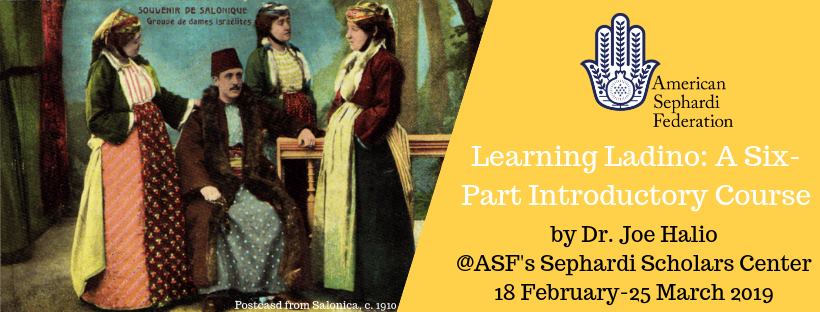
Ladino is a dialect of Spanish and has many regional variations of its own. This mini-course will introduce the nuances of Ladino, and we will conduct a comparative study of both spoken and written Spanish and Ladino, with Latin and Hebrew characters.
Six Part Course. 18 February – 25 March
Each Monday, 6:00-8:00 PM
Monday, 18 February: Introduction to Ladino: pronunciation, spelling, variations.
Monday, 25 February: American Ladino
Monday, 4 March: Turkish Ladino
Monday, 11 March: Greece: Salonician and Monastirli Ladino
Monday, 18 March: Comparative Liturgy: Psalms, Piyyutim, and Agada
Monday, 25 March: Student reflections
Dr. Joe Halio was raised in a Sephardic family of immigrants from Salonica and Turkey. His grandfather, Albert Torres, publisher of La Vara, and his father, Hank Halio, author of Ladino Reveries, taught him to speak Ladino. Years spent at the Sephardic Home for the Aged, the Kastoriali Kehila in Brooklyn, and the Sephardic Jewish Center of Forest Hills, as well as his travels to Turkey, Greece, and Israel, gave him additional perspective on the Ladino language. His extensive contact with native speakers and scholars of Ladino and Sephardic culture, as well as his large library of Ladino literature of all kinds, has provided him with rich opportunities to study and teach the native language and history of the Sephardim.
Knowledge of modern spoken Spanish is preferable. Texts will include material written in the USA, the Balkans, and Turkey, as well as audio and visual references. Because spoken language cannot be separated from culture in which it exists, knowledge of Sephardic history and culture is recommended, but not essential. Six weekly 2 hour sessions will cover an introduction to Ladino pronunciation, reading and writing Ladino, and regional variations. Cultural material may include historical documents, liturgy, folklore, and popular sources.
Objective
To clarify the differences between modern Spanish and Ladino dialects, to facilitate research and use of the Ladino dialect, and to promote enjoyment of Ladino and Sephardic culture and history.
Scope
We will speak, read, and write Ladino in various contexts, both popular and scholarly.
Texts
Handouts, websites, references to available library and archival material.
Requirements
Basic understanding of spoken Spanish and Sephardic history and culture preferred.
Approach to learning
Class participation, individual research, and presentations as desired.
Decorum
No cellphones, computers, recording, etc., unless used in presentations, with permission of the instructor.
Classes will take place @The ASFs Sephardi Scholars Center