The Mother of Exiles, Emma Lazarus, and America’s Founding
Dear Friends,
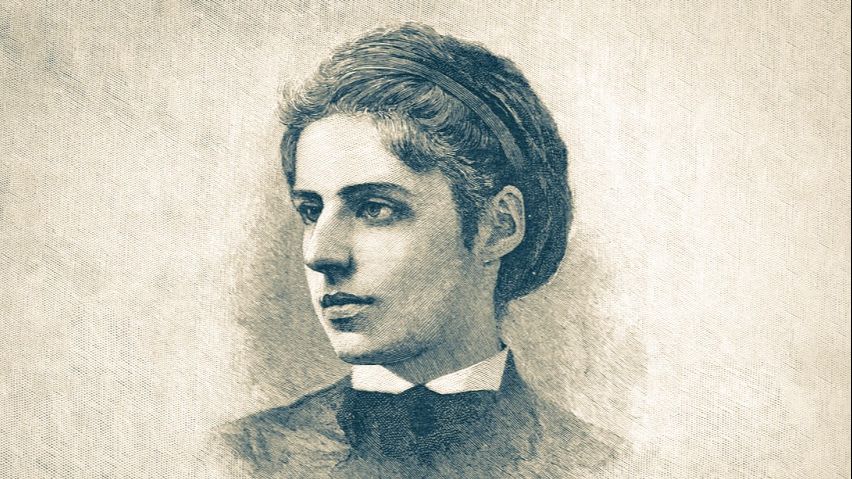
Today is the 176th birthday of Emma Lazarus, one of the most fascinating literary figures of 19th century American history. ASF Broome & Allen Fellow Leonard Stein gave a tour de force lecture, “Jewish Spain in American Tongue: Emma Lazarus’ Sephardic Return,” in multiple languages and based on original archival research discoveries that is well worth (re-)watching to mark the occasion.
Poet, playwright, critic, journalist, and a self-proclaimed “Jewish outlaw,” Lazarus (1849-1887) became famous for her sonnet, “The New Colossus,” a transcendent vision of American purpose that adorns the Statue of Liberty (“Give me your tired, your poor/ Your huddled masses yearning to breathe free,….”). Today, that poem has transcended its author in fame — and controversy .
In March, a French Member of the European Parliament started a debate that quickly spread online about whether the Statue of Liberty should be reclaimed or returned. Matt Walsh, a populist commentator and occasional “poet,” insisted upon keeping the Statue, but only in a desecrated form shorn of its significance. “I do think we should remove that dumb poem about the ‘huddled masses’ and send that to them…. People talk about that stupid poem like it’s some kind of founding document. It was written in 1903. It wasn’t even an original part of the statue, much less an original part of our nation’s founding,” wrote Walsh.
While “Liberty Enlightening the World” (Lady Liberty’s formal name) was a gift of France to the United States of America to mark the Declaration of Independence’s centennial, the victory of the Union in abolishing slavery, and Franco-American friendship, the pedestal on which she stands was paid for by the American people. In support of that great eleemosynary endeavor, specifically the American Committee for the Statue of Liberty’s fundraising campaign with a very long name (“Art Loan Fund Exhibition in Aid of the Bartholdi Pedestal Fund for the Statue of Liberty”), Lazarus was persuaded to write a poem befitting what she called the “Mother of Exiles.”
“[I]nspired by her own Sephardic Jewish heritage, her experiences working with refugees on Ward’s Island, and the plight of the immigrant,” Lazarus’ purpose in 1883 (not 1903, 16 years after her death), was to welcome immigrants upon arrival, as well as to raise the funds for the Statue’s NYC abode. More than 120,000 Americans responded positively, voting with their hard-earned contributions to the cause. The pedestal donors’ intent for the Statue is lost on Walsh, as well as the antisemitic commenters who were quick to point out Lazarus’ Jewishness as a trump card to thinking about our creedal nation.
Indeed, Lazarus was a descendant of the 23 Sephardic refugees from Recife, a Shearith Israel (“Remnant of Israel”), whose flight from the Inquisition brought them to New Amsterdam (later New York) and the founding of America’s 1st Jewish community, over 120 years before the Declaration of Independence. Put another way, Lazarus’s American ancestry is likely older and more illustrious (her relatives include Supreme Court Justice Benjamin Cardozo, as well as Annie and Maud Nathan) than many of her contemporary “nativist” detractors, whose ancestors came later and who have obviously failed to assimilate what it means to be an American.
Coming from an Irish background, Walsh might be interested in Commander-in-Chief of the Continental Army George Washington’s 2 December 1783 letter to “the volunteer Associations & other Inhabitants of the Kingdom of Ireland” in New York City. Washington prayed that Americans would set an “Example” for other nations “successfully contending in the Cause of Freedom.” After praising Ireland’s “bold & manly conduct” seeking redress and wishing “the blessings of equal Liberty & unrestrained Commerce may yet prevail more extensively…,” Washington turned to the meaning of immigration to the would-be Land of Liberty:
The bosom of America is open to receive not only the opulent & respectable Stranger, but the oppressed & persecuted of all Nations & Religions; whom we shall welcome to a participation of all our rights & privileges, if by decency & propriety of conduct they appear to merit the enjoyment.
As America’s first President, George Washington returned to these themes when writing to the Sephardic Congregation at Newport on 18 August 1790. “Citizens of the United States of America,” according to Washington, “have a right to applaud themselves for having given to mankind examples of an enlarged and liberal policy [i.e., the Declaration of Independence and Constitution]: a policy worthy of imitation. All possess alike liberty of conscience and immunities of citizenship.” Transcending tolerance to achieve liberty and justice for all was only made conceivable because “happily… the Government of the United States… gives to bigotry no sanction and persecution no assistance.”
In these difficult times, when antisemites of all parties abound and give cause to be afraid for the future, let us resurrect (so to speak) the meaning of America as envisioned by our Founder George Washington and his fellow creators of the architecture of freedom, as embodied by the Statue of Liberty, as beautifully expressed by Emma Lazarus’s poetry, and as experienced in the lives of millions of Americans. And, on this day and throughout the year, “May the father of all mercies scatter light and not darkness in our paths….”
“Towards peace, love, and justice,”
Executive Director, American Sephardi Federation
P.S. Please support the ASF with a generous, tax-deductible contribution so we can continue to cultivate and advocate, preserve and promote, as well as educate and empower!
For more information about sponsorship opportunities, donating securities, or planned giving options, please email info@americansephardi.org or leave a message at 212.294.8350. A financial professional from AllianceBernstein is standing by to speak with you. To donate by mail, please send a check payable to “American Sephardi Federation” to 15 W 16th St., New York, NY, 10011.
~~~~~~
Upcoming Events or Opportunities
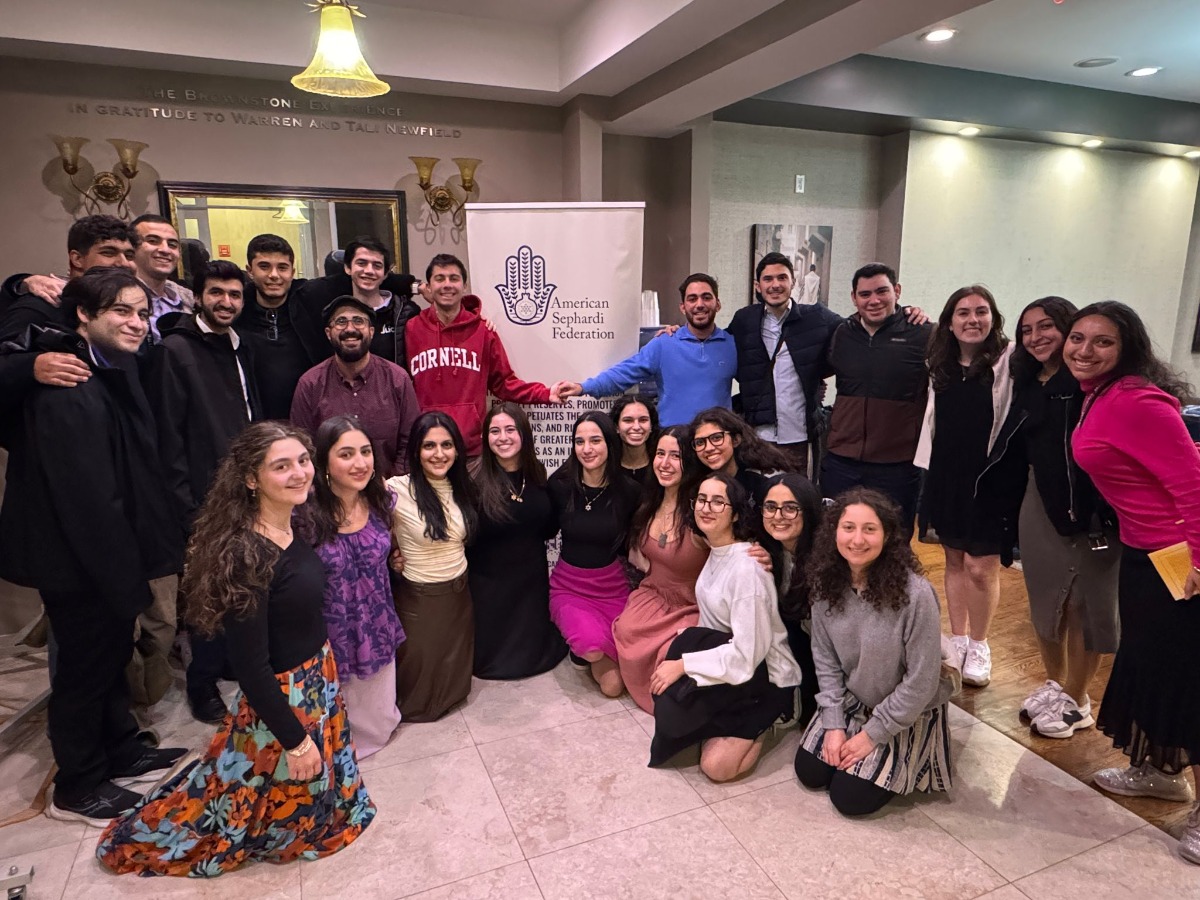
The American Sephardi Federation’s Sephardi House Fellowship is a unique learning, community-building, and leadership development program that infuses the diversity, creativity, and vibrancy of the Sephardic spirit into Jewish student life—while also advancing Jewish unity and vitality on campus.
Bringing together a select cohort of Jewish students from colleges across the United States, our program is the only national yearlong fellowship dedicated to deepening a sense of Jewish belonging through an immersion in the multifaceted history, cultures, and wisdom of the Sephardic and Mizrahi world.
For more information about ASF’s Sephardi House Fellowship, visit: www.sephardi.house
Apply Now!
Deadline: 1 August 2025, 11:59pm ET
For questions email the National Director of Sephardi House, Ruben Shimonov (ruben@americansephardi.org) and CC Sephardi House Engagement Associate, Stella Salmon (stellabsalmon@gmail.com).
~~~~~~~
Our friends at Qesher in partnership with the American Sephardi Federation present:
Jewish Tunisia: at a crossroads of civilizations
“Tunisia, the former seat of Cartaghe’s empire, has been home to different Jewish communities for more than 2000 years. Its central location at a crossroads of civilizations led to multiple influences in food, culture, language and identity. Rafram will take us through the different elements of the complex Jewish layer of Tunisia, which took a fateful turn in 1967 after the Six-Day War. Rafram will talk about how Jewish life looks today in Tunisia and about his work as a visual artist, which blends biography and Jewish identity in contemporary Tunisia.”
Sunday, 27 July at 3:00PM EST
Sign-up Now!
Tickets: $9-$18
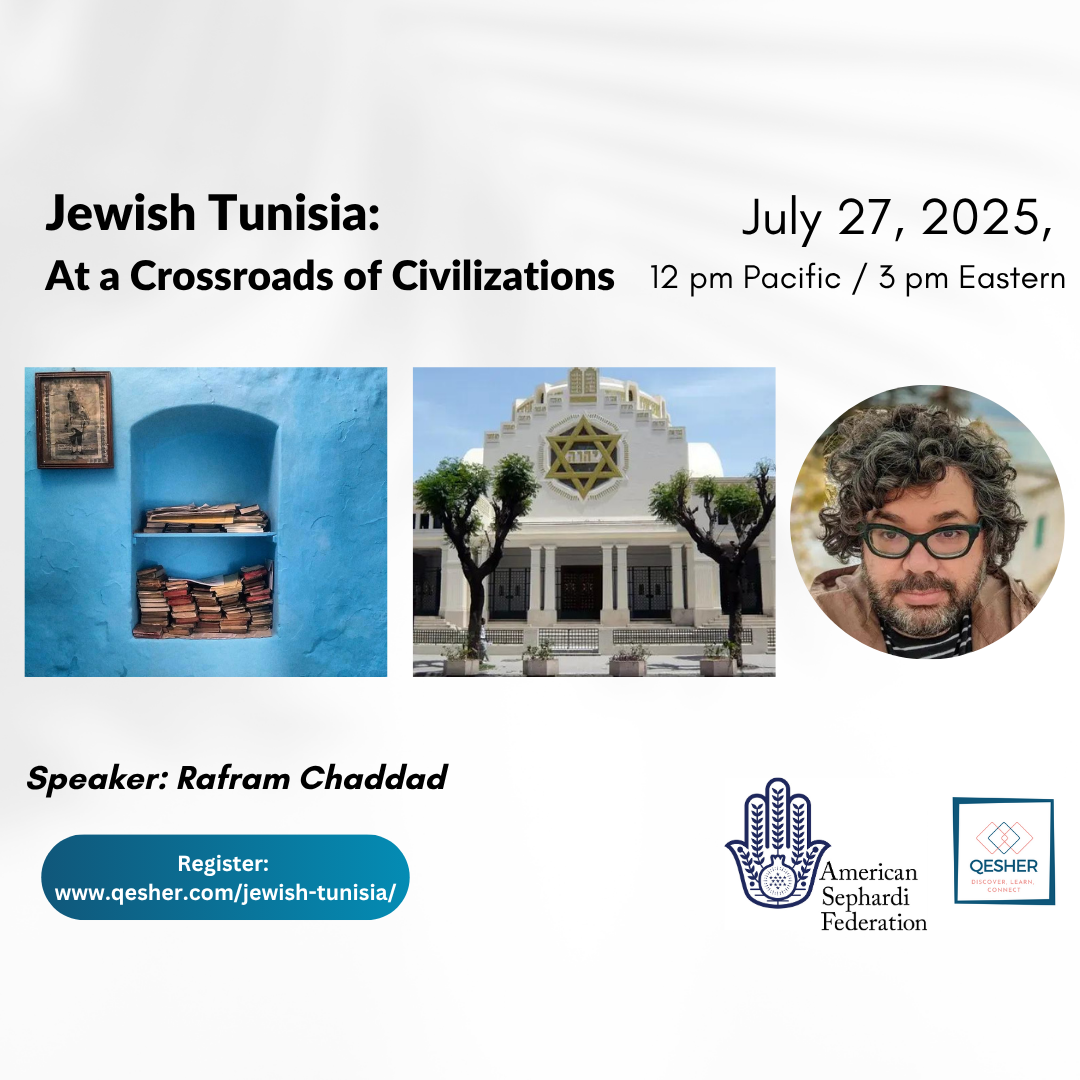
About the speaker:
“Born on the island of Djerba off the coast of Tunisia, Rafram Chaddad is an artist whose photographs, films, and multi-media installations rethink the archive, migration narratives, and what it means to belong.
Working between Tunis and New York, Rafram’s work reflects on his personal life experiences and comments on broader socio-political issues including migration and displacement, identity and belonging. Over the past twenty years, he’s created dozens of short films and installations, which have been exhibited worldwide in cultural institutions, galleries, and museums, including:
Kunst im Tunnel, Dusseldorf; Kunstraum, New York; Kayu Lucie Fontaine Gallery, Bali; Lucie Fontaine, Milan; ArteEast foundation, New York; Halle 14, Leipzig; and Zalatimo, east Jerusalem. Chaddad has held solo shows at the Mucem Museum in Marseilles and the Maximilian Forum in Munich, among others.”
~~~~~~
Our friends at Qesher in partnership with the American Sephardi Federation present:
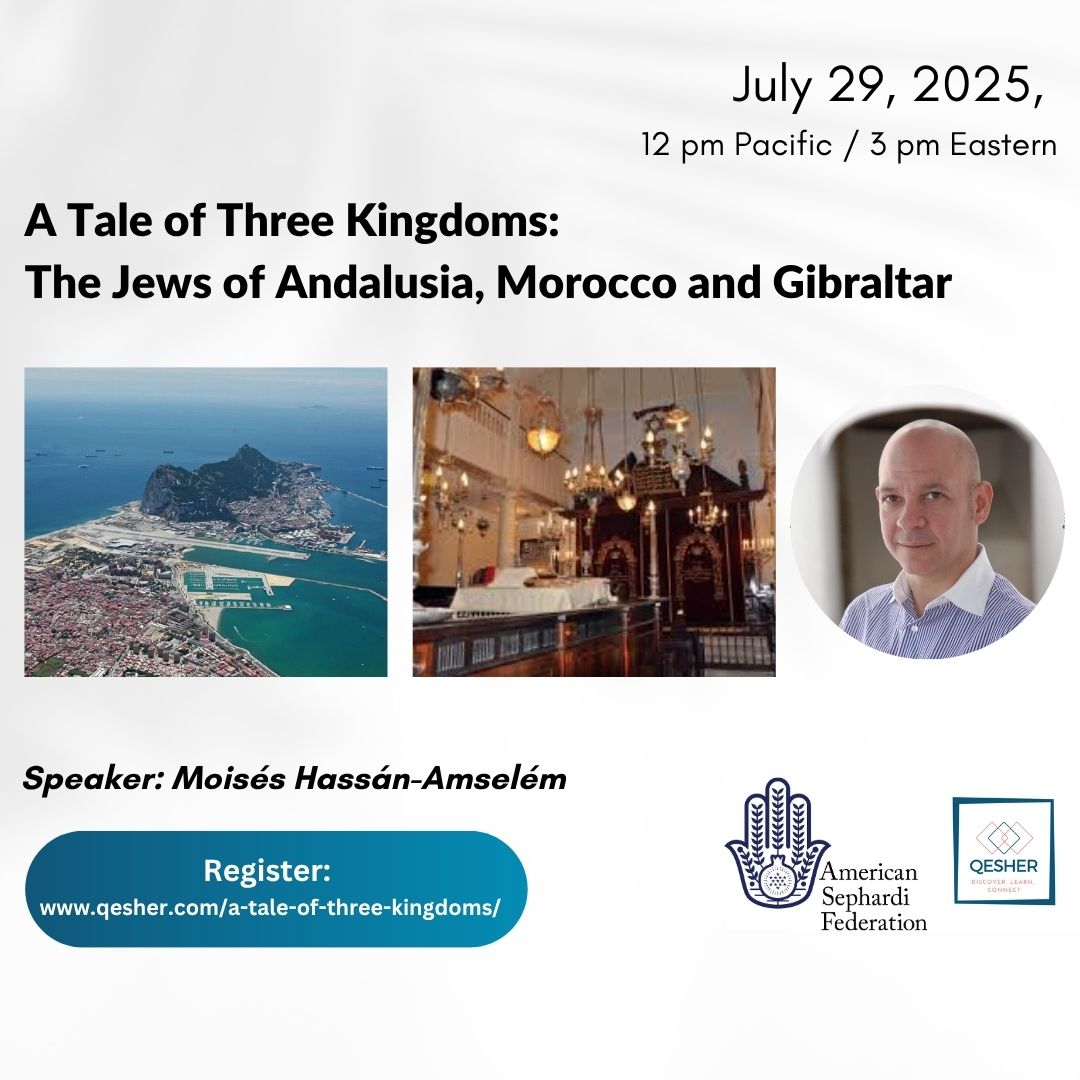
A Tale of Three Kingdoms: The Jews of Andalusia, Morocco, and Gibraltar
Tuesday, 29 July at 3:00PM EST
Sign-up Now!
Tickets: $9-$18
About the talk:
“…while the Jerusalemite exile community of Sepharad shall possess the towns of the Negev” (Obadiah 1:20)
“Andalusía (Andalucía) -the southern region of Spain once considered the most advanced and educated society in the western world, and where Judaism developed profusely and reached great heights of excellence, is the same land where all of this came to an abrupt end. This is the land where, on an unfortunate day of heart-breaking memory, an infamous decree was published -within the walls of the most beautiful palace anyone could ever imagine- and forced into exile a group of Spaniards whose only sin had been to think differently about their relationship with God.
Some of these Jews went south crossing the Strait of Gibraltar and settled down in the land of the Wattasid Sultan Abu Zakariya Muhammad al-Saih al-Mahdi. There they became a scholarly mercantile elite and quickly dominated Jewish communal life in the land already known as Morocco. Two hundred years later, some descendants of these Jews from Morocco returned -mostly as traders- to Gibraltar, a rock of less than two square miles located at the very bottom of the Iberian Peninsula that had just become part of the British Empire after the Spanish Succession war. They were given the right of permanent settlement in 1749 and since then, there has been a significant Jewish presence in the Rock.”
About the speaker:
“Moisés Hassán-Amselém, born in Seville of Moroccan heritage, is an honorary lecturer on ~Holocaust-Shoa Studies and Antisemitism at the University “Pablo de Olavide” in Seville, Spain.
He was an Exchange student in California during his senior year in High School. After his graduation, Moises returned to Spain and attended the University of Seville, where he obtained a law degree in 1995. However, he decided to make a completely career change and focus on the Jewish history of Spain. Therefore he set out to found Jewish Spain Tour, a fully licensed Tour Operator specializing in Jewish travel inside the Iberian Peninsula as well as in Morocco.
In addition to his role at the University “Pablo de Olavide”, Moisés is also involved in informal Jewish education.”
~~~~~~
Our friends at LESJC in partnership with the American Sephardi Federation, and Congregation Mickve Israel present:
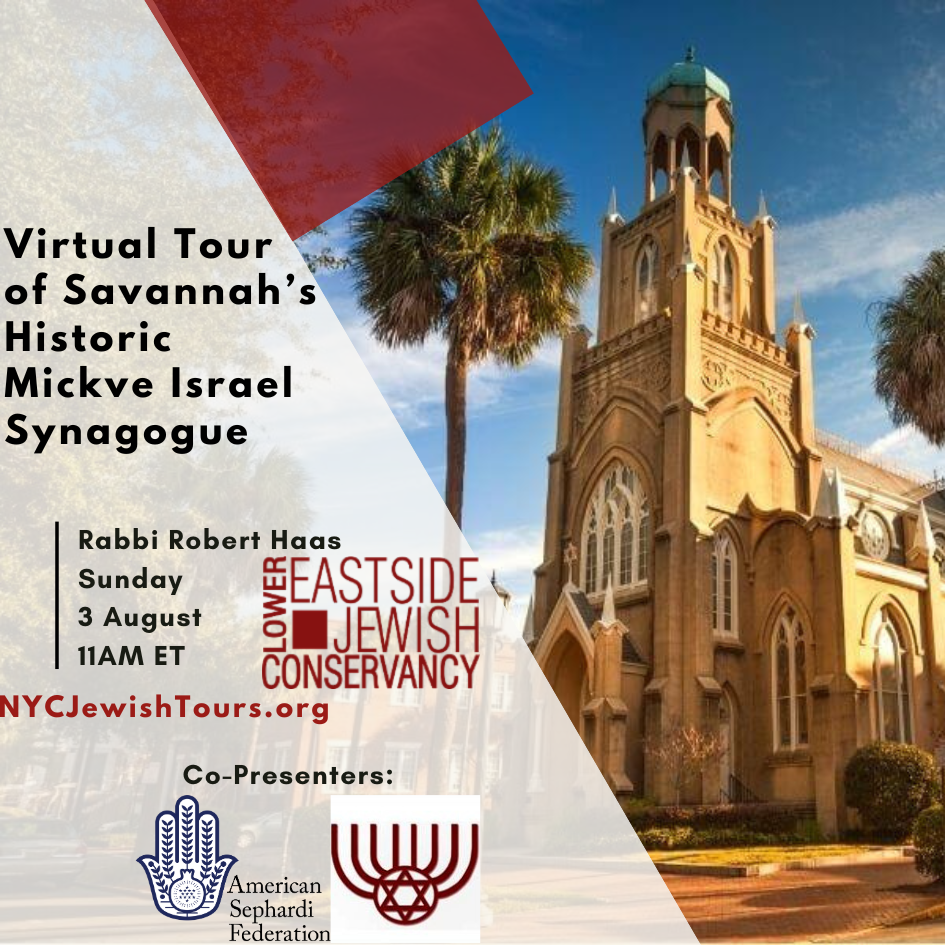
Virtual Tour of Savannah’s Historic Mickve Israel Synagogue
Shalom y’all! Join us for an exclusive virtual tour of America’s third oldest Jewish Congregation and the only neo-Gothic synagogue in the United States. In 1733, a group of mostly Spanish & Portuguese Sephardic Jewish immigrants arrived in Georgia from England, where they had found refuge from the horrors of the Inquisition. Bringing with them a Torah scroll from London’s Bevis Marks, the group settled in Savannah and founded Mickve Israel, the state’s first synagogue, in July 1735. Construction of the sanctuary began in 1876 and was completed in 1878. New York architect Henry G. Harrison pure neo-Gothic design reflected the fashionable architecture of the Victorian era. Congregation Mickve Israel was named one of the “15 Most Beautiful Synagogues in the World” by Condé Nast Traveler and rated among the “15 BEST Things to Do in Savannah” by Trip Advisor.
Sunday, 3 August, 11:00 AM 12:30 PM
Sign-up Now!
Tickets: $10
About the guide:
Your guide for this tour will be Rabbi Robert Haas, a native of McAllen, Texas, who became the 14th spiritual leader of Congregation Mickve Israel in Savannah, Georgia, in 2012. After receiving his B.S. from the University of Texas at Austin, he began his first career as an elementary school teacher before matriculating at Hebrew Union College in Jerusalem and Los Angeles, where he earned his Master’s Degree and Rabbinical Ordination. After graduation, he served as an associate rabbi in Dallas and in Houston, Texas. He then spent a year volunteering in Africa with American Jewish World Service before moving to Savannah. Rabbi Haas is a sought-after comedian, lecturer, preacher, and interfaith leader, regularly speaking and performing for organizations, radio shows, colleges, theaters, houses of worship, and institutions.
~~~~~~
Our friends at Qesher in partnership with Nora Kaplan Learn-in-trips presents:
Jewish History Tours to Spain
BARCELONA-CORDOBA-GRANADA
SEVILLA-TOLEDO-MADRID
Embark on a 12-day journey this October and November 2025 to experience the history of Jews in Sepharad: explore museums and world heritage sites, walk through the old cobbled lanes of Jewish quarters, take in the splendid architecture, and enjoy delicious food and Spanish wine.
Learn about the Golden Age of Jewish life in Spain on this unique, family-run Jewish Heritage Tour.
26 October – 6 November, 2025
Early Bird Price: EUR 5,700 if booked by 26 July, 2025
For questions or more information, please visit www.norakaplan.com or email alexis.learnintrips@gmail.com.
Note: While this is not an ASF program, the American Sephardi Federation is proud to serve as a promotional partner for this unique educational experience.