Two Jewish Songs, Ancient and Israeli
30 April 2025
In Memory of Rabbi Aqiva’s student-soldiers who died in the war against the Roman occupation of Judea (132 – 36 CE) during this time of year, and in memory of all those who have fallen in the wars to found and defend the State of Israel. May the memory of their sacrifice foster greater unity among the people of Israel.
Click here to dedicate a future issue in honor or memory of a loved one

Upcoming Events ◊ ASF Sephardi Shop ◊ Sephardi World Weekly ◊ ASF IJE ◊ ASF Sephardi House ◊ Archive◊ Donate
The American Sephardi Federation’s Sephardi Ideas Monthly (SIM) by Dr. Aryeh Tepper is a continuing series of essays and interviews from the rich, multi-dimensional world of Sephardi thought and culture that is delivered to your inbox every month.
The April, 2025, issue of Sephardi Ideas Monthly (SIM), inaugurates a new series on Jewish music. Music occupied a central role in Jewish life in ancient times, both in the Temple and in prophetic schools, and it continued to enliven Jewish communities across Jewish history. Today, as modern men and women living in technologically advanced societies, we can commune with the muse through recorded music from around the world at any place and at any time. But, as Allan Bloom noted in his prescient 1987 bestseller, The Closing of the American Mind, our access to music is accompanied by an unprecedented thoughtlessness when it comes to music’s power: “The phenomenon is both astounding and indigestible.” So for both Jewish and universal human reasons, we turn our attention to the enchanting world of rhythm and tune.
Upcoming issues of SIM will feature essays on music composed by thoughtful writers and thinkers and interviews with celebrated composers, bandleaders, musicians, and paytanim. We begin our new series with Rabbi Dr. Marc D. Angel’s essay, “Thoughts on the Song of Moses,” slightly revised and originally written for the 7th day of Passover.
(Photo courtesy of JBS/YouTube)
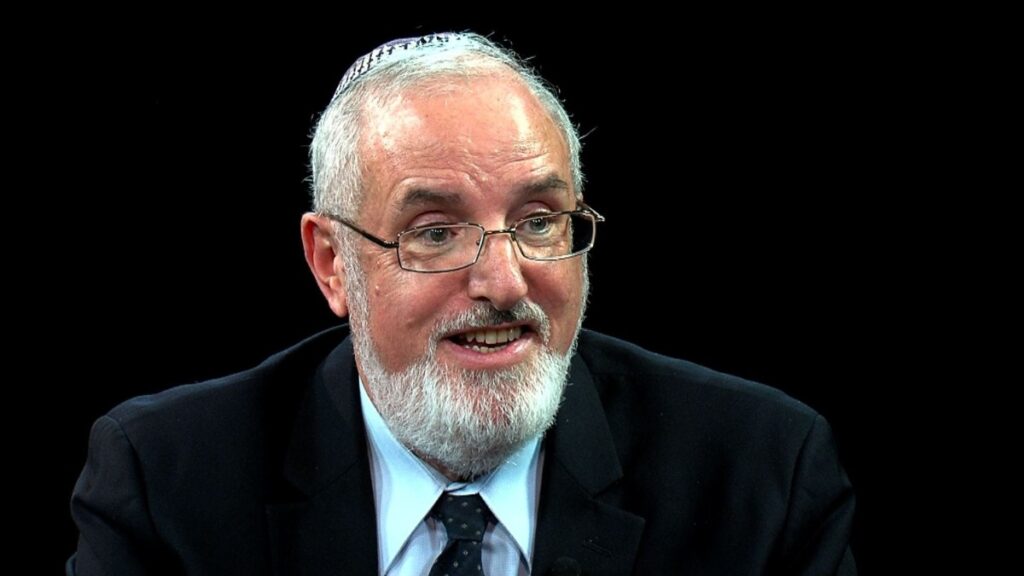
Rabbi Marc Angel is a scholar, prolific author, Rabbi emeritus of Congregation Shearith Israel, the Spanish and Portuguese Synagogue in New York City, an ASF Advisory Board Member, and the Founder and Director of The Institute for Jewish Ideas and Ideals. A tireless advocate for, and embodiment of, the deeply rooted but cosmopolitan character of Classical Sephardic Judaism, R’Angel begins his essay with an intriguing teaching that he once heard from a humble Jerusalem mystic in the early 1970s.
According to the mystical teaching, there is a musical ladder that ascends three rungs: from music with lyrics, to instrumental music without lyrics, to silence. At the peak, silence enables us to listen to our souls. In his essay, R’Angel connects this three-fold teaching to the calligraphic form in which the Song of Moses is written in the Torah, alternating between text and extended empty spaces. This form—letters, letters and spaces, spaces—shows, in turn, how “we actually can sing the Song of Moses on different levels of consciousness.” He then connects the mystical three-fold teaching to a path of spiritual development that the great 19th c. Sephardi sage from Sarajevo, Rabbi Eliezer Papo (1785-1826), found in the passages leading up to the Song of Moses. The different parts of R’Angel’s essay, from the Jerusalem mystic, to the form of the Song of Moses, to R’Papo’s teaching, then link up in their own crescendo “as we sing our songs on deeper and deeper levels, and learn to listen to the sound of our own souls.”
It is fitting that we open our series on music with a thoughtful and thought-provoking essay that explores the Jewish people’s most ancient song for wisdom about music, and that features the most lucid voice of Classical Sephardic Judaism today in America, R’Marc D. Angel. Because today is also Israel’s Memorial today, R’Angel’s essay is followed by a song for Israel’s fallen soldiers.
Thoughts on the Song of Moses
by Rabbi Marc D. Angel
While in Jerusalem many years ago, I met a wise, humble man who was something of a mystic. In one of our conversations, he told me: There are three kinds of music. The first kind has melody, harmony, rhythm and words. This is the standard popular or folk song, easily understood, easy to remember. The second kind has melody, harmony and rhythm but no words. This is more profound. It cannot express itself in words, since it is too deep for words. The third kind of song is not only wordless, there is also no melody, harmony or rhythm. This is the deepest music, the music of the soul. It is so very deep and so very silent, that it goes to the very core of our being. When we have experienced this third kind of music, we have come close to God.
I think of this message each year when we read the Song of Moses on the Seventh Day of Pesach.
In our Torah scrolls, the Song of Moses is written in a form that differs from the rest of the Torah. Instead of prosaic words filling the page in rows, in the song of Moses, blank spaces are interspersed within the text. While this formal difference might simply reflect the poetic nature of the text, it also might convey a deeper message, consistent with the teaching of the Jerusalem mystic.
If we just look at the ink, we can focus on a song–with words and a melody.
If we look at the ink and the blank spaces together, however, we can conceive of a different kind of song–one where the melody, harmony and rhythm play a more dominant role, and the words are less important.
But if we concentrate on the blank spaces, we can focus on the deepest kind of song–one where the content and emotion are too powerful and too profound to be expressed in any kind of sound.
We actually can sing the Song of Moses on different levels of consciousness. On the obvious level, it is a song of thanksgiving to the Almighty. It reflects simple, pure joy at a miraculous redemption. On a deeper level, the literal meanings of the words fade from our attention as we attune our souls to the spiritual rhythm of salvation. On the deepest level, however, we transcend the words and the melody and penetrate into a palpable silence. We attain the mysterious eternal music of a soul that comes into confrontation with the Almighty.
Rabbi Eliezer Papo (1785-1826), a great sage from 19th c. Sarajevo, known by the name of his classic moral treatise, Pele Yoetz (“The Wondrous Counselor”), heard a spiritual crescendo in the verses preceding the Song of Moses. First, “Israel saw the Egyptians dead upon the seashore” (Exodus, 14:30). The Israelites felt immediate relief at seeing their enemies dead. Then, “Israel beheld the great power which the Lord had shown against Egypt” (14:31). The Israelites reached a higher level of insight. They weren’t just happy that their enemies were vanquished, but recognized that it was the power of God that brought this salvation to them. Then, “the people revered the Lord” (14:31). The Israelites, upon recognizing God’s providence and power, ascended to the next level of spirituality: fear of God. “And they believed in the Lord…” The Israelites attained the highest level: faith, absolute trust in God. One might view these stages of spiritual development ― relief at physical salvation, wonder at God’s power, and trust grounded in awe ― as harmonizing with the three kinds of music delineated by the Jerusalem mystic. The Song of Moses carries us from the words, to the wordless melody, to the spiritual realm of music that transcends both words and melody and finds its home in silence.
The Pesach festival is a time of celebration of the Israelites’ redemption from their servitude in Egypt. But as we commemorate the miraculous freedom from physical bondage, we must understand, as progress towards the Giving of the Torah at Sinai on Shavuot, that the Passover festival is also devoted to our spiritual re-awakening. Each of us has his and her individual song, the underlying melody which imbues our lives with meaning. As we sing our songs on deeper and deeper levels, and learn to listen to the sound of our own souls, we approach the grand spiritual fulfillment of which we are capable.
Coda:
Sephardi Ideas Monthly asked R’ Angel about the identity of the mysterious mystic from Jerusalem. R’ Angel’s responded:
I don’t remember his name. I met him in Jerusalem in 1972 when he was a neighbor of a friend. Perhaps it’s symbolic and appropriate that he remain anonymous.
Feature: A Song for Israel’s Memorial Day
(Screenshot courtesy of YouTube)
Yom HaZiqaron, Israel’s Memorial Day, begins in Israel after sunset on Tues., April 29th, and concludes Wednesday afternoon, April 30th. Israel’s Independence Day then begins after sunset on Wednesday.
Ma Avarech (“How Shall I Bless Him”) is a song written by Rachel Shapira in memory of her classmate, Eldad Krook, who was killed during the Six Day War in 1967. The song is traditionally performed on Yom HaZiqaron in honor of Israel’s fallen soldiers.
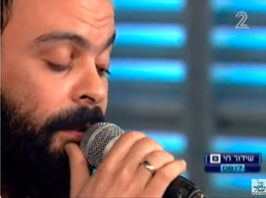
In this live 2010 performance on Israeli television, Amir Benayoun offers a rendition straight from the gut. Joining the program’s host and hostess in the studio is Rabbi Amos Netanel, whose son, Capt. Jonathan Netanel, fell in Gaza in June, 2009. Pictures of Jonathan, z’’l, appear occasionally throughout the clip.
Ma Avarech (“How Shall I Bless Him”)
by Rachel Shapira
How should I bless him, with what should he be blessed?
Is it this boy? The angel asked (2X)
And he blessed him with a shining smile
And he blessed him with big seeing eyes
To catch every flower, animal and bird
And a heart to feel all he sees
How should I bless him, with what should he be blessed?
Is it this youngster? The angel asked (2X)
And he blessed him with legs to dance
And a soul to remember all the rhythms
And a hand that collects shells on the beach
And a listening ear for old and young
How should I bless him, with what should he be blessed?
Is it this young man? The angel asked (2X)
And he blessed his powers with experienced hands
To succeed in controlling the power of steel
And legs to dance along the journey
And lips singing the rhythm of command
How should I bless him, with what should he be blessed?
Is it this man? The angel asked (2X)
I gave him all that I could give
A song, a smile, and legs to dance with
A soft hand and a beating heart
And what else should I bless you with?
How should I bless him, with what should he be blessed?
Is it this boy, the soft young man? (2X)
This youngster, is an angel now
Will not be blessed any longer, not blessed anymore
God, God, God –
If only You blessed him with life
~~~~~~~

Exploring Sephardic Customs and Traditions
By Rabbi Marc D. Angel
Over the centuries, Jewish communities throughout the world adopted customs that enhanced and deepened their religious observances. These customs, or minhagim, became powerful elements in the religious consciousness of the Jewish people. It is important to recognize that minhagim are manifestations of a religious worldview, a philosophy of life. They are not merely quaint or picturesque practices, but expressions of a community’s way of enhancing the religious experience. A valuable resource for Sephardim and Ashkenazim alike.
Maimonides, Spinoza and Us: Toward an Intellectually Vibrant Judaism
By Rabbi Marc D. Angel
A challenging look at two great Jewish philosophers, and what their thinking means to our understanding of God, truth, revelation and reason. Moses Maimonides (1138–1204) is Jewish history’s greatest exponent of a rational, philosophically sound Judaism. He strove to reconcile the teachings of the Bible and rabbinic tradition with the principles of Aristotelian philosophy, arguing that religion and philosophy ultimately must arrive at the same truth. Baruch Spinoza (1632–77) is Jewish history’s most illustrious “heretic.” He believed that truth could be attained through reason alone, and that philosophy and religion were separate domains that could not be reconciled. His critique of the Bible and its teachings caused an intellectual and spiritual upheaval whose effects are still felt today. Rabbi Marc D. Angel discusses major themes in the writings of Maimonides and Spinoza to show us how modern people can deal with religion in an intellectually honest and meaningful way. From Maimonides, we gain insight on how to harmonize traditional religious belief with the dictates of reason. From Spinoza, we gain insight into the intellectual challenges which must be met by modern believers.
~~~~~~~

We are thrilled to announce the much anticipated 27th New York Sephardic Jewish Film Festival with the participation of Michel Boujenah, Fortuna, Roya Hakakian, Enrico Macias, and Yael Naim.
Please mark your calendar for Sunday, June 8th, as we kick off a week-long cinematic journey of untold stories celebrating the diversity, poignancy, and humor of the Greater Sephardic world.
Join us for unforgettable experiences filled with exclusive screenings, insightful discussions, and captivating performances.
Stay tuned for the full calendar and ticket information!
~~~~~~~
Upcoming Events or Opportunities
Our friends at Qesher present:
Qesher Book Club:
“Sacred Places Tell Tales: Jewish Life and Heritage in Modern Cairo”
Historian Yoram Meital interprets Cairo’s synagogues as exquisite storytellers. The synagogues still stand in Cairo, and they shed new light on the social, cultural, and political processes that Egyptian society and the Jews underwent from 1875 to the present. Studying old and new synagogues in the Egyptian capital, their locations, the items they stored, and the range of religious and nonreligious activities they hosted reveals the social heterogeneity and the diverse ways in which modern Jewish sociocultural identity was constructed within Cairo’s Sephardi, Ashkenazi, and Karaite communities.
Meital contends that studying the congregations and the social services provided in synagogues reveals the local Jewish community’s customs, cultural preferences, socioeconomic gaps, and class divisions.
You can read more and order the book here.
Tuesday, 6 May 3:00PM EST
Sign-up Now!
Tickets: Free Event; RSVP Required

About the author:
Yoram Meital is a professor of Middle East Studies at Ben-Gurion University. He has conducted extensive research on various topics related to Arab societies during the modern era, focusing on Egypt’s social, cultural, political, and legal history. From 2017 to 2021, he served as the historical consultant to the Jewish community in Cairo, actively participating in documenting and preserving Egyptian-Jewish heritage. His publications include Revolutionary Justice: Special Courts and the Formation of Republican Egypt (2017); Peace in Tatters: Israel, Palestine, and the Middle East (2006); and Sacred Places Tell Tales: Jewish Life and Heritage in Modern Cairo (2024).
~~~~~~~
Bookhouse
American Sephardi Federation’s cooperative initiative with Centro Primo Levi, and Dan Wyman Books presents:
A Renaissance Story: David Reubeni, Diplomat and Spy
Zvi Ben-Dor Benite will speak about the story of David Reubeni. R
Arriving in Rome in 1523, a Yemeni Jew proclaimed himself the “Prince of the Lost Tribes” and leader of their 300,000-strong army. Pope Clement VII met with the enigmatic David Ha-Reuveni, who proposed an alliance against the Muslim Turks in exchange for the Holy Land, financial support, and a navy for the Jewish people. Why did so many Italians believe him, what transpired in Italy, and how did the events conclude?
Wednesday, 7 May at 7:00PM
ASF-Center for Jewish History
15 W 16th Street, NYC
Reservation required: rsvp@primolevicenter.org
Bookhouse, American Sephardi Federation’s corporate initiative with Centro Primo Levi (CPL) and Dan Wyman Books, is a small space for study, discussion, and creativity connected to Jewish book culture: from manuscripts to pulps, from Talmud to Yiddish Socialism, from Printers to Bookshops to Readers.
Dan Wyman Books will be exhibiting a rotating collection of approximately 300 rare and important books related to these topics, all of which will be available for browsing and purchase.
~~~~~~~
The Museum of the Bible, the American Sephardi Federation and Jewish Theological Seminary (JTS) present:
Sacred Words: Revealing the Earliest Hebrew Book
Explore the new Library exhibit, featuring the remarkable story of the earliest Hebrew book.
On View 19 March – 17 July 2025
@Jewish Theological Seminary
3080 Broadway (at 122nd Street)
New York City
The exhibit is open to the public during Library Hours.
Group tours are available.
Please contact Dr. David Kraemer, Joseph J. and Dora Abbell Librarian and Professor of Talmud and Rabbinics, for more information.

About the Exhibit:
After 1,300 years of untold travels along the Silk Roads, the oldest Hebrew book reveals its extraordinary story. In Sacred Words, guests will behold the oldest-known Hebrew book, containing Sabbath-morning prayers, liturgical poems, and the world’s oldest Haggadah, which was mysteriously written upside down. Learn about the book’s content, its origins on the Silk Roads, and the multicultural cooperation that brought it first to Museum of the Bible in Washington, DC. This sacred book has a story to tell. Come discover it.
This exhibition was created in partnership with the American Sephardi Federation and the Museum of the Bible.
