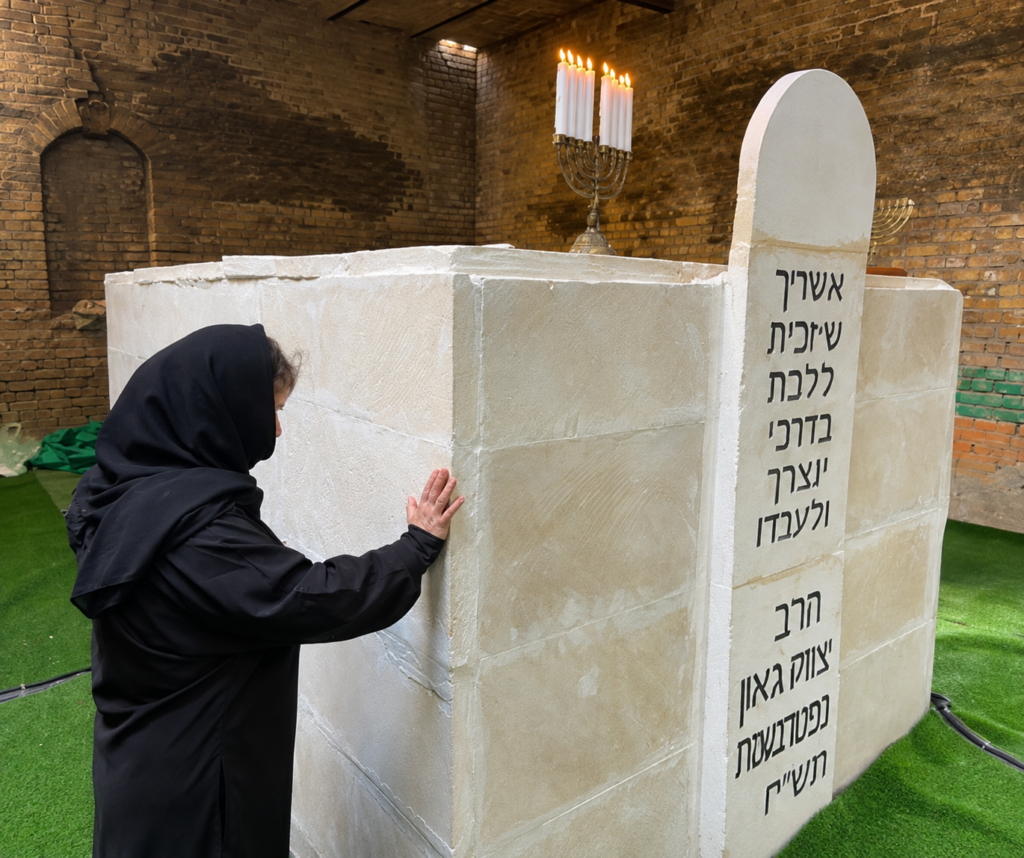
We had the pleasure of speaking to our friend and colleague, Dr. Khalida Fouad Eliyahu Heskel Moallem about her early life in Iraq, why she stayed in the country after her entire community fled, and how she has been feeling this past week about the response surrounding the opening of the Shamash Jewish museum in Baghdad.
A dentist by profession, Khalida has devoted her life and her energy to attempting to preserve the culture, heritage and history of Jews in Iraq, in the hopes that one day, she may be able to restore a once thriving community. She is one of 6 Jews remaining in Baghdad, and one of 100 Jews remaining across Iraq and Kurdistan. Less than a century ago, Iraq housed a Jewish population of over 150,000 people.
Khalida was born to a Jewish family in September 1962 in Baghdad’s Al-Alwiyah district.
Growing up, she attended two of Iraq’s most well-known Jewish schools, Menachem Saleh-Daniel and then Frank Iny. She learned to swim at the popular Al-Wiyah club, where Jewish families would gather to play cards and backgammon and enjoy their downtime together.
Regarding religious life, Khalida remembers the Meir Tweig Synagogue fondly and recalls celebrating Passover and Simchat Torah specifically. In the summer time, an old Jewish man named Yakoub, who used to wear a traditional Siddara hat, popularized by King Faisal I, would teach her and the other children Hebrew inside the synagogue.
Mixed with the fun and beautiful memories of walking down Abu Nawas street and buying an ice cream or sampling the masgouf fish, Khalida remembers a tumultuous childhood and upbringing for the Jewish community. She recalls seeing her mother crying as she told the family that yet another Jewish person was kidnapped in broad daylight in the streets, tortured or killed.
“They took our telephones, we couldn’t go to university or study and people’s assets were frozen.” Khalida told us.
Upon asking her why her family stayed in Iraq when the rest of the community fled, both legally and illegally, she said:
“Most of my family are doctors. My mother was a famous gynecologist and my brother was an orthopaedic doctor. I am also a dentist myself. Patients would come from all over Baghdad, Hilla and Mosul to see my mother and we felt that we had a duty to the people to stay and help them medically.”
Khalida has courageously survived several violent attempts on her life, one of which has left her severely injured. To this day she receives daily pushback and opposition to her Jewish restoration work, with varying degrees of severity.
However, none of this stops her. She told us:
“When I saw everyone in my community leave, I felt sad. They left everything because of the injustices they faced and they were forced to leave. When you’re comfortable in your home, that’s your home. They loved their country. I felt so sad when I went to synagogue and I saw nobody there. It wasn’t like it was in the past. I felt very sad and my dream since then has been to restore the presence of Jews in Baghdad.”
Khalida has spent years looking after the Meir Tweig synagogue and also attempting to restore Baghdad’s Jewish cemetery, so that her community members from across the world can feel that their contribution and presence has not been entirely erased.
We asked Khalida how she felt about the fact that Iraqi-Jews cannot visit the new museum or visit Baghdad generally, due to legitimate safety concerns. She told us:
“This museum isn’t necessarily just for Jews. In fact, it is for Iraqis to learn about the Jews that used to live here. This is the heritage of our country. Everything is happening step by step and my dream one day of course is for the Jews to be able to come and visit the museum. However, this is already a very big step.”
Thank you, Dr. Khalida, for the tremendous work you do, despite the risks you face every day, all because you have an admirable dream of teaching non-Jewish Iraqis about a community that was instrumental in making Iraq what it once was.
The American Sephardi Federation is proud to serve as your primary partner in ensuring the preservation and promotion of Iraqi Jewish heritage in Iraq and around the world. May your efforts be rewarded and may the Jews of Iraq never be forgotten.
Thank you to Ciara Shalome (themizrahistory) for the inspiration and this special contribution to The Sephardi Report.